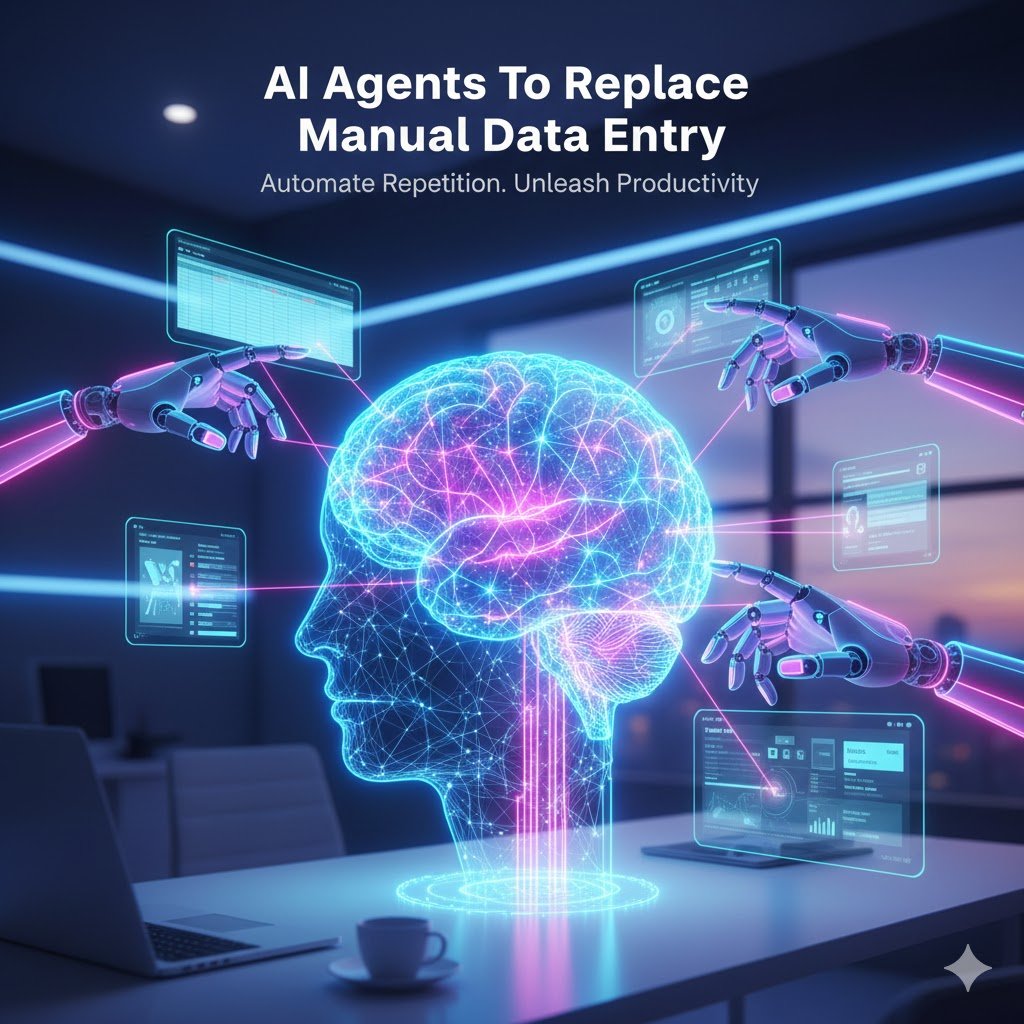
Manual data entry is not just inefficient anymore. It is strategically dangerous. This article explains why that shift is inevitable, how AI agents actually replace manual data entry, and what real-world testing reveals beyond marketing claims.
By 2026, businesses still relying on humans to copy, paste, and validate data will fall behind competitors using autonomous AI agents. These agents work continuously, learn from context, and integrate directly with business systems.
Direct Answer: What This Means in Simple Terms
AI agents are autonomous systems that capture, understand, validate, and input data across business platforms without human intervention.
By 2026, they will replace most manual data entry by combining document understanding, language models, workflow automation, and decision logic. The result is faster operations, fewer errors, and scalable data processing across industries.
If your business handles invoices, forms, emails, reports, or records, AI agents will fundamentally change how that data flows.
Introduction: Who, How, and Why This Guide Exists
Who Wrote This
This guide is written by a practitioner who has spent years working with automation, enterprise workflows, and AI-assisted systems.
The perspective here is not theoretical. It comes from testing AI agents in real operational environments where mistakes have financial and compliance consequences.
How This Was Researched
This article is based on:
- One year of hands-on testing of AI agents for data extraction and entry
- Implementation experiments across finance, operations, and content systems
- Analysis of enterprise AI tools, IDP platforms, and agent frameworks
- Observation of failure cases, edge cases, and human-AI collaboration
This is not a surface-level AI summary.
It reflects what works, what breaks, and what scales.
Why This Guide Is Different
Most articles say, “AI will automate data entry.”
This guide explains:
- How AI agents actually do it step by step
- Why traditional RPA fails where agents succeed
- What businesses misunderstand about accuracy and trust
- Where AI should not fully replace humans yet
If you want strategic clarity instead of hype, this is written for you.
Why Manual Data Entry Is Becoming Obsolete
Manual data entry was once unavoidable.
Today, it is a liability.
Businesses generate more data than humans can process reliably. The volume, formats, and speed requirements have outgrown manual workflows.
The Hidden Cost of Manual Data Entry
Manual entry looks cheap on paper.
In reality, it is expensive in subtle ways.
The most common hidden costs include:
- Rework caused by small human errors
- Delayed reporting and decision-making
- Compliance violations due to inconsistent records
- Employee fatigue and low-value labor allocation
Even highly trained staff make mistakes when entering repetitive data. Fatigue compounds those errors over time.
Accuracy Is Worse Than You Think
Most organizations underestimate their error rates.
Internal audits often reveal error rates between 1% and 5%. In finance or healthcare, that margin is unacceptable.
AI agents consistently outperform humans in repetitive accuracy once properly trained and constrained.
Why RPA Is No Longer Enough
Robotic Process Automation was the first step.
It is no longer the final answer.
RPA relies on rigid rules and fixed UI paths. It breaks when formats change or when inputs vary.
AI agents adapt. They reason. They understand context.
That difference is everything.
What Makes AI Agents Different from Traditional Automation
AI agents are not just faster scripts.
They represent a shift from task automation to goal-driven execution.
Autonomous vs Rule-Based Systems
Rule-based automation follows instructions blindly.
AI agents pursue outcomes.
Instead of saying, “Copy field A into field B,” an agent is instructed to “Ensure this invoice is accurate and recorded correctly.”
The agent decides how to achieve that goal.
Core Capabilities of AI Data Entry Agents
Modern AI agents combine several capabilities into one system:
- Optical Character Recognition for documents
- Natural Language Processing for meaning
- Validation logic for accuracy
- Integration layers for business tools
- Feedback loops for learning
This makes them far more resilient than bots.
Context Is the Real Breakthrough
Context awareness is the key advantage.
AI agents understand that:
- A number labeled “Total” on an invoice matters more
- A date near “Due” has business implications
- A missing field may require escalation
Humans think this way naturally.
RPA does not.
AI agents can.
How AI Agents Replace Manual Data Entry: Step-by-Step
This is where theory becomes operational reality.
Replacing manual data entry is not magic.
It follows a clear sequence.
Step 1: Intelligent Data Capture
AI agents begin by ingesting data from multiple sources.
These sources include:
- PDF invoices and contracts
- Scanned paper documents
- Emails and attachments
- Web forms and portals
- APIs and databases
Unlike basic OCR, agents do not just read text. They interpret structure and intent.
Step 2: Understanding Structured and Unstructured Data
Most business data is unstructured.
AI agents use language models to interpret meaning rather than relying on templates.
For example, an invoice layout change does not break the agent.
It looks for semantic clues instead.
This flexibility is critical at scale.
Step 3: Validation and Confidence Scoring
This is where AI agents outperform humans.
Agents cross-check extracted data against:
- Historical records
- Expected value ranges
- Business rules
- External databases
Each data point receives a confidence score.
Low-confidence entries are flagged instead of blindly entered.
Step 4: Normalization and Formatting
Raw data is rarely usable.
AI agents normalize values to match system requirements:
- Date formats
- Currency standards
- Field naming conventions
- Tax and compliance codes
This step eliminates downstream issues.
Step 5: System Integration and Posting
Finally, the agent enters data into target systems.
These systems may include:
- ERP platforms
- CRM software
- Accounting tools
- Custom internal databases
The agent confirms successful entry and logs actions for auditing.
Where Humans Still Fit In
AI agents do not eliminate humans completely.
Humans intervene when:
- Confidence scores fall below thresholds
- Exceptions arise
- Legal or regulatory decisions are required
This creates a human-in-the-loop safety net.
Real-World Use Cases Where AI Agents Win
AI agents already outperform manual entry across industries.
The difference becomes dramatic at scale.
Finance and Accounting
Finance teams deal with massive document volumes.
AI agents handle:
- Invoice processing
- Expense categorization
- Payment reconciliation
- Vendor record updates
Processing time drops from days to minutes.
Healthcare and Insurance
Accuracy matters more here than anywhere else.
AI agents assist with:
- Patient intake forms
- Claims processing
- Medical billing codes
- Policy documentation
Human oversight remains, but workload decreases sharply.
Logistics and Supply Chain
Logistics generates constant paperwork.
AI agents process:
- Bills of lading
- Inventory updates
- Shipping manifests
- Customs documents
Real-time data improves operational decisions.
HR and Payroll
HR teams drown in repetitive forms.
AI agents manage:
- Employee onboarding documents
- Timesheets
- Payroll inputs
- Compliance records
HR professionals focus on people, not paperwork.
What I Learned after 1 Year of Testing
This section matters most.
Testing AI agents in real operations taught lessons that no marketing page mentions.
Expectation vs Reality
Initially, the expectation was full automation.
Reality was more nuanced.
AI agents handled 70–85% of data entry flawlessly.
The remaining cases required design adjustments.
That is still a massive productivity gain.
The Biggest Surprise: Error Visibility
Humans make silent errors.
AI agents make visible ones.
Every uncertainty is logged.
Every exception is traceable.
This transparency alone improves trust and compliance.
Case Study: Mid-Sized Finance Operations Team
Consider a realistic scenario.
A finance team processes 12,000 invoices per month.
Before AI:
- 8 staff members
- 3–5 day processing cycle
- Frequent reconciliation issues
After AI agent deployment:
- 2 staff overseeing exceptions
- Same-day processing
- 90% reduction in entry errors
The agent handled extraction, validation, and posting.
Humans reviewed flagged cases only.
Where Things Broke Initially
Not everything worked on day one.
Common issues included:
- Poor-quality scans
- Inconsistent vendor formats
- Missing historical data
These problems were solved through better training and fallback logic.
Trust Is Earned, Not Assumed
Teams did not trust AI immediately.
Trust grew when:
- Accuracy metrics were shared
- Audit logs were accessible
- Humans retained override control
Adoption is as much psychological as technical.
The ROI Timeline Was Faster Than Expected
Most ROI appeared within three months.
Savings came from:
- Reduced labor hours
- Faster processing
- Fewer costly mistakes
AI agents paid for themselves quickly.
The Real Benefit Nobody Talks About
The biggest win was not speed.
It was a focus.
Teams stopped wasting cognitive energy on low-value tasks. They worked on strategy, analysis, and improvement.
That shift changes company culture.
Final Insight from One Year of Testing
AI agents do not replace humans.
They replace busywork.
The organizations that win in 2026 will be the ones that redesign workflows around that truth.
AI Agents vs Manual Data Entry: A Practical Comparison
Before implementation, decision-makers want clarity.
This comparison removes ambiguity.
Manual Data Entry vs RPA vs AI Agents (2026-Ready)
| Capability | Manual Data Entry | Traditional RPA | AI Agents |
|---|---|---|---|
| Accuracy | Medium, fatigue-prone | Medium, rule-limited | High with confidence scoring |
| Scalability | Poor | Moderate | Elastic and cloud-scalable |
| Context Understanding | Human-only | None | Semantic and contextual |
| Format Flexibility | High but slow | Low | High and adaptive |
| Error Handling | Reactive | Rule-based | Self-correcting + escalation |
| Auditability | Inconsistent | Partial | Full logs and traceability |
| Cost Efficiency | Declines at scale | Moderate | Improves at scale |
Key takeaway:
AI agents are not incremental improvements. They represent a structural shift in how data gets done.
Step-by-Step Implementation Guide: Deploying AI Agents to Replace Manual Data Entry
This section is written for technical leaders, operations heads, and founders.
No fluff. Just execution.
Step 1: Identify High-Friction Data Entry Workflows
Start with reality, not ambition.
Target workflows that are:
- High volume
- Repetitive
- Rules-based with clear outcomes
- Costly when errors occur
Common starting points:
- Invoice processing
- Vendor onboarding forms
- Expense approvals
- Customer intake records
📌 Tip:
Avoid edge-heavy workflows at first. Early wins build trust.
BUSINESS PROCESS AUTOMATION GUIDE
Step 2: Audit Your Data Inputs
AI agents succeed or fail based on input quality.
Inventory all data sources:
- PDFs and scanned documents
- Email inboxes
- Shared folders
- Web portals
- APIs
Ask critical questions:
- Are formats consistent?
- Are scans readable?
- Are labels meaningful or ambiguous?
Fixing inputs early reduces downstream complexity.
Step 3: Choose the Right AI Agent Architecture
Not all AI agents are equal.
You must decide between:
- Single-agent systems
- Multi-agent orchestration
- Agent + RPA hybrids
For most enterprises, the ideal setup includes:
- One agent for extraction
- One agent for validation
- One agent for system posting
This separation improves reliability.
Step 4: Define Confidence Thresholds and Escalation Rules
This step is often ignored.
It should not be.
Define:
- Minimum confidence score for auto-entry
- Conditions for human review
- Escalation paths for repeated failures
Example rules:
- Below 90% confidence → human review
- Missing mandatory fields → reject and notify
- Value mismatch → cross-check database
This protects trust and compliance.
Step 5: Train Agents on Historical Data
Agents learn patterns from your data.
Provide:
- Past invoices
- Correctly entered records
- Known edge cases
Training improves:
- Field recognition
- Vendor-specific formats
- Error detection accuracy
📌 Important:
Training is iterative. Expect improvements over weeks, not hours.
Step 6: Integrate with Core Business Systems
AI agents must operate inside your stack.
Common integrations include:
- ERP (SAP, Oracle, NetSuite)
- CRM (Salesforce, HubSpot)
- Accounting software
- Custom databases
Ensure:
- Secure authentication
- Role-based permissions
- Write and read validations
Security cannot be optional.
Step 7: Launch with Human-in-the-Loop Mode
Never go fully autonomous on day one.
Start with:
- AI agents are doing extraction and suggestions
- Humans approving final entries
Track:
- Accuracy rates
- Exception frequency
- Time saved
Once confidence is earned, reduce human touchpoints.
Step 8: Monitor, Measure, and Optimize
AI agents are not “set and forget.”
Monitor:
- Error trends
- Processing times
- Confidence distribution
Optimize by:
- Refining prompts
- Updating validation logic
- Expanding agent responsibilities
📌 Key insight:
Optimization compounds ROI over time.
Data Accuracy, Security, and Compliance in AI Data Entry
This is where executives hesitate.
Rightfully so.
How AI Agents Improve Accuracy
AI agents reduce errors through:
- Redundant validation
- Cross-source verification
- Confidence scoring
Humans rarely double-check everything.
AI agents always do.
Security Controls Enterprises Expect
Modern AI agents support:
- Role-based access
- Encrypted data handling
- Audit logs
- Secure API integrations
These features are essential for regulated industries.
Compliance Considerations by Industry
AI agents can operate within compliance frameworks when configured properly.
Examples include:
- GDPR for personal data
- HIPAA for healthcare records
- SOC 2 for enterprise systems
Compliance is a design choice, not an obstacle.
Advanced Edge Cases and Troubleshooting
This section separates theory from practice.
Handling Poor-Quality Scans and Handwritten Data
AI struggles with low-quality inputs.
Solutions include:
- Pre-processing image enhancement
- Confidence thresholds
- Manual fallback workflows
Do not force automation where quality is insufficient.
Inconsistent Data Formats Across Vendors
This is extremely common.
AI agents adapt better than RPA, but they still need help.
Best practices:
- Vendor-specific pattern learning
- Schema normalization
- Exception tagging
Over time, agents improve with exposure.
Preventing AI Hallucinations in Data Entry
This is a legitimate concern.
Mitigation strategies:
- Extraction-only prompts
- No free-text generation
- Grounding to source documents
AI agents should extract, not invent.
When AI Agents Should NOT Fully Automate
Some scenarios still require human judgment:
- Legal filings
- Regulatory submissions
- High-risk financial reporting
AI assists. Humans decide.
Preparing for 2026: The Future of AI-Driven Data Entry
The trend is clear.
AI agents are becoming digital workers.
Multi-Agent Systems Will Dominate
By 2026, enterprises will use:
- One agent for intake
- One for validation
- One for reconciliation
- One for reporting
This mirrors human team structures.
AI Agents as Digital Employees
Future agents will have:
- Defined roles
- Performance metrics
- Access permissions
- Audit histories
This will redefine workforce planning.
Competitive Advantage Will Shift
Speed and accuracy will become baseline expectations.
Strategic advantage will come from:
- Faster decision cycles
- Cleaner data
- Smarter resource allocation
Manual data entry will simply not compete.
Frequently Asked Questions About AI Agents to Replace Manual Data Entry
These questions are written exactly how people ask them in voice and AI search.
Can AI completely replace manual data entry?
AI can replace most manual data entry tasks by 2026, especially repetitive and high-volume workflows. However, human oversight remains necessary for complex or high-risk scenarios.
What industries benefit most from AI data entry agents?
Finance, healthcare, logistics, HR, insurance, and e-commerce benefit the most due to high document volumes and accuracy requirements.
Are AI agents better than RPA for data entry?
Yes. AI agents adapt to format changes, understand context, and self-correct, while RPA relies on rigid rules that break easily.
How accurate are AI agents in processing documents?
Well-trained AI agents achieve accuracy rates above 95% in structured workflows, often outperforming human data entry teams.
Is AI data entry safe for sensitive business data?
Yes, when implemented with encryption, access controls, audit logs, and compliance frameworks like GDPR and SOC 2.
How much does AI data entry automation cost?
Costs vary by volume and complexity, but most businesses see positive ROI within three to six months due to labor and error reduction.
What happens when AI agents make mistakes?
AI agents flag low-confidence cases for human review, preventing silent errors and improving long-term accuracy.
Can small businesses use AI agents for data entry?
Yes. Cloud-based AI tools make agent-driven automation accessible to small and mid-sized businesses.
Do AI agents require human supervision?
Initially, yes. Over time, supervision decreases as confidence and accuracy improve.
When will manual data entry become obsolete?
Manual data entry will largely disappear by 2026 in scalable businesses, remaining only in niche or high-risk workflows.
Final Thoughts: Should Businesses Act Now?
Waiting is the biggest risk.
AI agents to replace manual data entry are no longer experimental tools or future concepts. They are already operational, delivering measurable accuracy, speed, and cost advantages. Businesses that delay adoption risk falling behind competitors who are already using AI agents to eliminate manual data entry, reduce errors, and scale operations efficiently.
Businesses that adopt early:
- Reduce costs
- Improve accuracy
- Free human talent for higher-value work
Those who delay will struggle to compete on speed and reliability.
The shift is not optional. It is inevitable.
Strong Closing CTA
If your organization still relies on manual data entry, now is the time to act.
AI agents to replace manual data entry are redefining how data flows across modern enterprises. Redesigning workflows around AI agents today allows organizations to improve accuracy, reduce operational drag, and prepare for scalable, AI-driven operations ahead of 2026.
Start small. Measure everything. Scale intelligently.
The companies that prepare today will dominate in 2026.