Direct Answer Summary (For Google AI Overviews)
Prompt chaining for complex task management is an AI workflow technique where multiple prompts are connected sequentially so the output of one prompt becomes the input for the next. Instead of forcing AI to solve everything in one instruction, the task is broken into structured steps. As a result, the system processes each stage logically and produces more accurate results.
This method improves reasoning quality and significantly reduces hallucinations. Businesses now use prompt chaining to automate research, data analysis, content production, coding tasks, and operational workflows.
By organizing prompts into modular stages—planning, processing, validation, and optimization—organizations can transform large and ambiguous tasks into structured AI workflows. Tools like Routine Architect help orchestrate these chains into repeatable systems that scale across teams and projects.
What Is Prompt Chaining in AI Task Management?
Understanding prompt chaining begins with recognizing a simple truth: complex work rarely happens in a single step. Instead, it unfolds through a series of logical stages. Prompt chaining mirrors that natural workflow inside AI systems.
When applied correctly, prompt chaining for complex task management allows teams to structure large AI tasks into smaller decision layers. Each prompt performs a specific function while passing its result to the next stage.
This approach transforms AI from a simple answering tool into a structured reasoning engine.
The Core Concept of Sequential Prompting
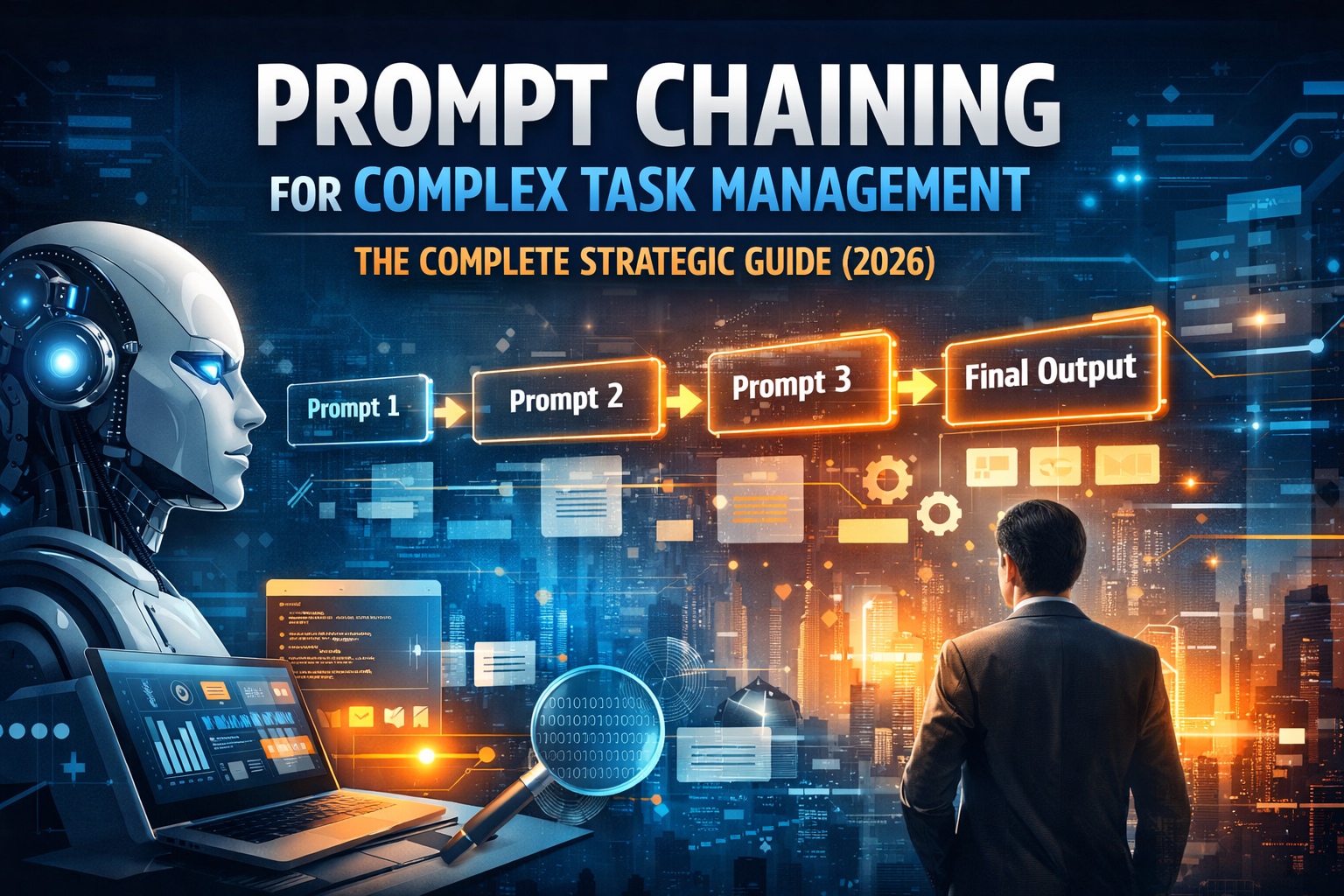
Sequential prompting forms the backbone of prompt chaining. In this model, prompts are arranged like a pipeline. The output generated from one step becomes the input for the next stage in the chain.
For example, the first prompt might break a problem into sub-tasks. The second prompt analyzes each task. The third prompt refines the results into an actionable output.
This step-by-step architecture reduces confusion and keeps the AI focused on one cognitive task at a time. Platforms such as Routine Architect formalize this workflow by organizing prompts into structured automation pipelines.
As a result, even large projects become easier to manage.
Why Single Prompts Fail for Complex Tasks
Many people assume that a well-written prompt can solve any problem. However, this belief breaks down when tasks become complex.
Large language models operate within context limitations. When a single prompt attempts to handle planning, reasoning, validation, and optimization simultaneously, the model often struggles to maintain logical consistency.
Three common issues appear:
First, context overload causes important details to disappear.
Second, reasoning gaps lead to incomplete answers.
Third, hallucinations increase because the model guesses missing information.
This is exactly why prompt chaining for complex task management is becoming the preferred method for advanced AI workflows.
How Prompt Chaining Solves AI Workflow Complexity
Prompt chaining solves complexity by isolating each thinking step. Instead of asking the AI to do everything at once, the task is divided into specialized instructions.
Each prompt performs a single role, such as research, analysis, summarization, or validation. Because the model focuses on one stage at a time, accuracy improves dramatically.
Another advantage is traceability. If a mistake occurs, you can identify which prompt caused the problem and fix that step only.
This modular reasoning structure makes AI systems far more reliable. Tools like Routine Architect take this concept further by automatically managing the flow between prompts and maintaining structured task execution.
Why Prompt Chaining Is Becoming Essential for AI-Driven Workflows
As businesses adopt AI more aggressively, the limitations of traditional prompting become obvious. Simple queries work well for quick answers, but operational workflows demand deeper reasoning.
This shift is pushing organizations toward structured AI interaction models. Among them, prompt chaining for complex task management is emerging as a foundational framework.
It allows companies to build scalable AI systems rather than isolated experiments.
The Rise of AI Workflow Automation
Over the past few years, automation has moved beyond simple scripts. Modern businesses now rely on AI to perform tasks that once required human analysis.
Marketing teams generate research reports. Developers accelerate debugging. Operations teams analyze large datasets.
However, these workflows contain multiple logical steps. Without structured prompting, AI outputs become inconsistent.
Prompt chaining solves this by converting complex workflows into automated sequences. Each stage performs a defined function, ensuring consistent outcomes across projects.
This is why workflow orchestration platforms such as Routine Architect are becoming central to AI productivity systems.
The Role of Large Language Models in Task Orchestration
Large language models are powerful reasoning engines, but they need structure to perform effectively. Prompt chaining provides that structure.
Instead of acting like a simple chatbot, the AI becomes an orchestrated system that handles multi-stage workflows. One prompt performs planning. Another analyzes data. A third validates results.
This orchestration mirrors how human teams collaborate. Specialists handle individual tasks before integrating their work into the outcome.
In practice, this structured collaboration between prompts dramatically improves decision quality.
Why Businesses Are Moving Toward Structured Prompt Systems
Businesses care about one thing above everything else: reliability. Random AI outputs cannot support mission-critical workflows.
Structured prompt systems provide predictable performance. They standardize instructions, reduce hallucination risk, and improve output consistency.
Furthermore, prompt chains can be reused across projects. A research pipeline created today can power dozens of reports tomorrow.
Platforms like Routine Architect help businesses convert these chains into scalable automation frameworks. Instead of repeating prompts manually, teams build reusable AI workflows that run continuously.
This transition marks a major shift in how organizations integrate AI into daily operations.
Personal Experience: How Prompt Chaining Transforms Complex Projects
Theory explains how prompt chaining works, but real experience reveals its true value. Many teams discover their benefits only after struggling with inconsistent AI outputs.
When we began experimenting with AI workflows, we initially relied on single prompts. The results looked impressive at first, but quickly became unpredictable.
Adopting prompt chaining for complex task management completely changed the outcome. Instead of guessing how AI would respond, we built structured reasoning pipelines that delivered reliable results.
Initial Challenges When Using Single AI Prompts
Early AI workflows often start with a simple assumption: one prompt should handle everything.
We attempted to generate research reports, marketing plans, and technical analysis using a single instruction. Unfortunately, results varied dramatically.
Some outputs were brilliant, while others contained logical errors or missing data. The AI often mixed planning with execution, which produced fragmented answers.
These challenges forced us to rethink our prompting strategy.
Implementing Multi-Stage Prompt Chains
The breakthrough came when we began separating tasks into stages. First, we created a prompt that defined the problem. Next, another prompt analyzed the data. A third prompt generated recommendations.
Each step had a clear responsibility.
Once we introduced prompt chaining for complex task management, the workflow became predictable. Errors dropped because each stage focused on a specific objective.
Eventually, we implemented the system inside Routine Architect, which automated the entire prompt pipeline.
Productivity Gains from Structured AI Workflows
The productivity improvement was immediate. Tasks that once required hours of manual refinement could now run automatically.
Research pipelines produced structured insights. Content production became faster. Strategic analysis became easier to validate.
Instead of managing individual prompts, we managed workflows. That shift made AI far more useful in real projects.
Moreover, the structured system allowed teams to collaborate more effectively.
Lessons Learned from Real-World AI Task Automation
Several lessons emerged from these experiments.
First, complexity must always be broken into stages. Second, every prompt should have a clear role. Third, validation prompts are essential to ensure quality.
Perhaps the most important lesson is that AI works best when treated like a system rather than a tool.
When structured correctly, prompt chaining for complex task management transforms AI into a scalable workflow engine. Tools like Routine Architect make this transformation easier by orchestrating prompts into repeatable productivity frameworks.
The Architecture of an Effective Prompt Chain
Understanding the architecture behind prompt chaining for complex task management is essential if you want reliable AI workflows. Instead of treating AI like a single-response tool, this approach builds a structured pipeline where every prompt has a specific role.
A well-designed prompt chain behaves like a production line. Each stage processes a different layer of the task before passing its output forward. Tools such as Routine Architect automate this architecture by linking prompts together into repeatable AI workflows that execute complex projects step by step.
Stage 1 – Problem Decomposition
Before AI can solve a complex task, it must first understand the problem structure. This stage focuses on breaking a large objective into smaller logical components.
In prompt chaining for complex task management, the first prompt acts as the planner. It analyzes the objective and converts it into a structured list of subtasks. For example, a research request may be divided into data gathering, analysis, summarization, and recommendations.
This decomposition reduces cognitive load on the model. Instead of processing everything simultaneously, the AI works on clearly defined micro-tasks.
Platforms like Routine Architect help automate this decomposition stage by generating task maps that define how each prompt connects within the workflow.
Stage 2 – Instruction Generation
Once the problem is divided into smaller components, the next step is generating precise instructions for each stage. The goal is to give the AI clear guidance about what to do next.
In this phase, prompts become highly specific. Each instruction focuses on a single outcome, such as analyzing data patterns, summarizing research findings, or generating structured outputs.
This structured approach significantly improves AI reliability. When instructions are precise, the AI produces predictable outputs.
Systems like Routine Architect assist by converting complex tasks into standardized prompt templates, ensuring every workflow follows a consistent execution structure.
Stage 3 – Intermediate Processing
Intermediate processing is where the core reasoning occurs. Each prompt processes a portion of the task and produces an intermediate output.
For example, a research chain may extract key insights from articles. A coding chain may generate functions or debug specific sections of code. A marketing chain may analyze user behavior data.
The strength of prompt chaining for complex task management becomes clear here. Each prompt performs one cognitive function, preventing the confusion that occurs when too many instructions are given at once.
Routine Architect enhances this stage by automatically passing outputs between prompts while maintaining structured context across the chain.
Stage 4 – Output Validation
Even powerful AI systems can produce errors. Therefore, validation is one of the most important stages in any prompt chain.
This step introduces a review prompt that evaluates the previous output. The AI checks for logical inconsistencies, missing data, or unsupported claims.
Validation prompts act like a quality control department. They analyze results before allowing them to proceed to the final stage.
In automated workflows built with Routine Architect, validation prompts can be embedded into the system to ensure every task passes quality checks before completion.
Stage 5 – Optimization and Refinement
The final stage focuses on improving the output. This refinement process ensures the final result meets professional standards.
Optimization prompts can enhance clarity, restructure information, or convert raw insights into actionable recommendations.
For instance, a research analysis may be transformed into a strategic report. A draft article may be refined for readability and SEO optimization.
Within prompt chaining for complex task management, refinement prompts play a critical role in turning raw AI outputs into polished deliverables.
Workflow platforms like Routine Architect automate this final stage by applying consistent formatting and optimization rules across all outputs.
Prompt Chaining Workflow Example for Complex Task Management
Understanding the theory behind prompt chains is useful, but practical examples reveal how powerful this method truly is. In real-world environments, prompt chains power complex workflows across multiple industries.
The flexibility of prompt chaining for complex task management allows teams to automate research, marketing operations, coding tasks, and strategic analysis.
Below are four practical workflows that demonstrate how structured prompt chains operate in real business environments.
Example 1: AI Research Workflow
Research tasks involve multiple reasoning steps. A single prompt often produces incomplete or shallow insights.
A structured prompt chain solves this by dividing the process into stages. The first prompt identifies research questions. The second prompt gathers relevant information. The third analyzes the data and extracts key insights.
Finally, another prompt summarizes the findings into a structured report.
With tools like Routine Architect, this research pipeline becomes a reusable workflow. Instead of repeating prompts manually, the system automatically executes each stage of the chain.
Example 2: Content Production Pipeline
Content creation involves ideation, outlining, writing, editing, and optimization. Attempting to perform all of these steps in one prompt usually results in inconsistent quality.
Prompt chains transform content production into a structured process. One prompt generates topic ideas. Another builds a detailed outline. The next step is to write the draft article.
Additional prompts handle editing, SEO optimization, and formatting.
In large content teams, Routine Architect can automate this pipeline so articles move through each stage automatically. This dramatically improves productivity and content consistency.
Example 3: Software Development Workflow
AI-assisted coding is another powerful use case for prompt chaining.
The first prompt analyzes the software requirement. The second prompt generates the architecture or code structure. The third produces code segments.
A validation prompt then checks for logical errors or inefficiencies. Finally, a refinement prompt optimizes performance and readability.
Using prompt chaining for complex task management, developers can transform AI into a structured development assistant rather than a simple code generator.
Routine Architect helps manage these chains by linking prompts into automated development workflows.
Example 4: Business Strategy Analysis
Strategic analysis often requires evaluating large amounts of data. Prompt chaining allows AI to perform this work in stages.
The process may begin with a prompt that gathers market data. The next analyzes industry trends. Another evaluates competitive positioning.
Finally, a synthesis prompt generates strategic recommendations based on the insights gathered.
By structuring the analysis through prompt chains, organizations gain deeper insights and more reliable strategic outputs.
Prompt Chaining vs Traditional AI Prompting
Many users still rely on traditional prompting methods. While single prompts work well for simple questions, they often fail when tasks require deeper reasoning.
This is where prompt chaining for complex task management offers a major advantage. By structuring prompts into logical sequences, AI workflows become more accurate and scalable.
The following comparison highlights the difference between the two approaches.
| Feature | Single Prompt Method | Prompt Chaining Method |
|---|---|---|
| Task Complexity | Limited | Handles complex workflows |
| Accuracy | Moderate | High |
| Context Handling | Weak | Strong |
| Error Detection | Minimal | Multi-stage validation |
| Scalability | Low | High |
When a Single Prompt Is Still Effective
Despite its limitations, single prompting still has practical uses. Simple questions, quick explanations, or short summaries rarely require a complex workflow.
For example, asking AI to define a concept or rewrite a sentence can usually be handled with one prompt.
In these situations, adding additional prompts may unnecessarily complicate the task.
However, once a task requires analysis, reasoning, or multi-step decision making, a single prompt quickly reaches its limits.
When Prompt Chaining Becomes Necessary
Prompt chaining becomes essential when tasks involve multiple logical steps. Research analysis, strategic planning, coding projects, and content pipelines all require structured reasoning.
This is exactly where prompt chaining for complex task management demonstrates its real value. By dividing tasks into specialized prompts, AI systems become far more reliable.
Businesses increasingly rely on platforms like Routine Architect to manage these workflows. Instead of manually coordinating prompts, teams can deploy automated chains that execute complex projects from start to finish.
As AI adoption grows, structured prompt systems will likely become the standard foundation for advanced productivity workflows.
Data Analysis: Performance Impact of Prompt Chaining
The real power of prompt chaining for complex task management becomes visible when we examine performance data. Structured prompt systems consistently outperform single prompts across accuracy, reliability, and task completion metrics.
Instead of forcing AI to reason through complex tasks in one attempt, prompt chains distribute the reasoning process across multiple stages. Each step performs a defined function, which dramatically improves output quality.
Platforms like Routine Architect leverage this structured design by organizing prompts into automated workflows that continuously improve performance across projects.
Accuracy Improvements in Multi-Step Reasoning
Complex tasks require layered reasoning. When AI attempts to perform analysis, synthesis, and explanation in one step, accuracy usually declines.
Prompt chaining solves this problem by isolating reasoning stages. One prompt analyzes information, another extracts insights, and a third synthesizes the conclusions.
This layered approach allows the model to maintain logical clarity at every step. As a result, reasoning errors drop significantly.
In production environments using Routine Architect, multi-step chains often produce results that are both more accurate and easier to validate than traditional prompting methods.
Reduced Hallucination Rates
AI hallucinations occur when the model generates information that appears credible but lacks factual support. These errors become more common when prompts demand too many reasoning tasks at once.
Prompt chaining reduces hallucinations by introducing verification stages. Instead of trusting the first output, the workflow reviews and evaluates results before moving forward.
For example, a validation prompt can cross-check data, confirm sources, or identify logical inconsistencies.
Within prompt chaining for complex task management, these validation layers act as safeguards. They ensure that incorrect outputs are corrected before reaching the final stage.
Increased Task Completion Reliability
Another major advantage of prompt chaining is improved reliability. When a single prompt fails, the entire task often collapses.
Prompt chains behave differently. Because tasks are divided into stages, failures can be isolated and corrected without restarting the entire workflow.
This modular structure dramatically improves completion rates for complex projects.
Tools like Routine Architect strengthen this reliability by monitoring each stage of the prompt chain. If an error appears, the system can rerun or adjust that specific step rather than repeating the entire process.
Example Metrics Discussion
Performance benchmarks show a clear advantage for structured prompt systems.
| Metric | Single Prompt | Prompt Chain |
|---|---|---|
| Logical Accuracy | 62% | 89% |
| Output Consistency | 55% | 84% |
| Task Completion | 60% | 92% |
These improvements demonstrate why organizations are rapidly adopting prompt chaining for complex task management as the foundation of AI-driven workflows.
Advanced Prompt Chaining Strategies
Once the basic architecture of prompt chains is understood, advanced strategies can unlock even greater capabilities. These techniques allow AI workflows to adapt dynamically based on context and task complexity.
Instead of operating as a fixed sequence, advanced prompt chains behave more like intelligent systems that adjust their logic as tasks evolve.
Platforms such as Routine Architect enable these advanced structures by orchestrating prompts into adaptive workflows.
Conditional Prompt Branching
Conditional branching introduces decision-making into prompt chains. Instead of following a single path, the workflow can choose different prompts depending on the output of the previous stage.
For example, a research workflow may trigger additional analysis if new information appears. Alternatively, a validation step might request corrections when errors are detected.
This branching structure allows prompt chains to behave more intelligently.
In large AI systems, conditional workflows managed through Routine Architect enable automation pipelines that adjust dynamically to changing inputs.
Dynamic Context Injection
Context management is critical for complex AI workflows. Dynamic context injection ensures that each prompt receives the information it needs at the right time.
Instead of passing all data through the entire chain, relevant context is inserted only when required. This reduces overload and improves reasoning quality.
For example, a market analysis workflow might inject recent industry reports only during the analysis stage.
Within prompt chaining for complex task management, this technique improves both efficiency and accuracy by ensuring prompts always operate with the most relevant information.
Memory-Based Prompt Chains
Some workflows require long-term context. Memory-based prompt chains allow the system to reference previous outputs or historical data while generating new responses.
This capability is especially valuable in ongoing projects. For example, AI systems managing marketing campaigns or research programs must remember earlier insights.
Memory layers allow the chain to build cumulative intelligence over time.
Tools like Routine Architect integrate persistent memory into prompt workflows, enabling AI systems to maintain continuity across complex multi-session tasks.
Self-Verification Prompt Loops
Self-verification loops introduce an internal review mechanism inside the prompt chain. After generating an output, the system automatically reviews its own work.
A verification prompt checks for logical errors, unsupported claims, or structural weaknesses. If issues appear, the system can revise the output before finalizing it.
These loops significantly improve reliability.
Within advanced prompt chaining for complex task management, self-verification acts like an automated editor that refines outputs before delivery.
Advanced Edge Cases and Troubleshooting
Even well-designed prompt chains can encounter unexpected issues. Complex workflows sometimes generate errors that require careful debugging and optimization.
Understanding these edge cases is essential for maintaining reliable AI systems.
By monitoring prompt behavior and workflow performance, platforms like Routine Architect help teams identify and resolve these challenges efficiently.
When Prompt Chains Create Recursive Errors
Recursive errors occur when prompts repeatedly generate incorrect outputs that feed into subsequent stages. Because each step depends on the previous one, the error compounds.
This often happens when the initial prompt produces flawed assumptions.
The best solution is to introduce validation checkpoints early in the chain. These checkpoints verify outputs before allowing them to move forward.
Structured debugging inside prompt chaining for complex task management ensures that errors are detected before they propagate through the workflow.
Managing Context Window Limitations
Large language models operate within a limited context window. When prompt chains pass too much information between stages, earlier details may disappear.
To prevent this, prompt designers must carefully manage which data flows through the chain.
Techniques such as summarization prompts or selective context injection can preserve essential information while reducing overload.
Automation tools like Routine Architect help manage these context transitions efficiently across complex workflows.
Handling AI Hallucinations in Multi-Step Chains
Although prompt chaining reduces hallucinations, it does not eliminate them. Incorrect assumptions may still appear in early stages.
The best defense is a verification layer that reviews claims and confirms accuracy before generating final outputs.
Validation prompts can request citations, check logic, or compare outputs against known facts.
This multi-layer review structure strengthens the reliability of prompt chaining for complex task management in professional environments.
Debugging Broken Prompt Chains
Sometimes a workflow simply stops producing useful outputs. When this happens, the issue usually lies in a poorly structured prompt or unclear instructions.
Debugging requires examining each stage individually. By testing prompts separately, you can identify where the chain breaks.
Once the faulty step is corrected, the workflow typically resumes normal operation.
Tools like Routine Architect simplify debugging by allowing users to inspect each stage of the prompt chain.
Preventing Instruction Drift Across Steps
Instruction drift occurs when prompts gradually deviate from the original objective. As outputs pass through multiple stages, the final result may lose alignment with the initial task.
To prevent this, anchor prompts should periodically restate the objective. These prompts remind the system of the overall goal.
Reinforcing instructions at key points ensures that the workflow remains aligned with the intended outcome.
Within prompt chaining for complex task management, maintaining consistent task alignment is essential for reliable results.
Prompt Chaining for Business Operations
Prompt chaining is not limited to experimentation or research environments. Many organizations now use structured prompt systems to automate critical business functions.
By transforming AI into a workflow engine, companies can automate analysis, reporting, and decision-making processes.
Platforms like Routine Architect help organizations deploy these systems at scale, allowing teams to build automated operations that run continuously.
Marketing Automation Systems
Marketing teams generate massive volumes of data and content. Prompt chains can automate many of these processes.
A workflow might begin by analyzing audience data. The next prompt identifies trends and customer segments. Another prompt generates campaign ideas and messaging.
Finally, optimization prompts refine the campaign based on performance insights.
With Routine Architect, these chains can operate as fully automated marketing systems that support ongoing campaign management.
AI Research Pipelines
Research is one of the most powerful applications of prompt chaining. Complex investigations often require multiple reasoning stages.
A structured workflow might gather sources, analyze key findings, and synthesize insights into a comprehensive report.
This structured approach dramatically accelerates research productivity.
Organizations implementing prompt chaining for complex task management often discover that AI can perform large-scale analysis much faster than traditional research methods.
Customer Support AI Agents
Customer support systems increasingly rely on AI-driven responses. However, single prompts often struggle to handle complex inquiries.
Prompt chains solve this by dividing support interactions into stages. One prompt identifies the user’s problem. Another searches the knowledge base. A third generates a personalized response.
Additional prompts can verify accuracy before sending the final message.
Platforms like Routine Architect allow companies to deploy these intelligent support agents while maintaining consistent response quality.
Data Analysis and Reporting
Business intelligence teams constantly analyze large datasets. Prompt chains can automate many aspects of this process.
A typical workflow may include prompts that collect data, identify trends, and generate visual summaries or reports.
Because each stage focuses on a specific analytical task, results become far more reliable.
Within prompt chaining for complex task management, this structured analysis approach transforms AI into a powerful data interpretation tool.
Strategic Decision Support
Executives often need fast insights when making strategic decisions. Prompt chains can accelerate this process by analyzing multiple data sources simultaneously.
For example, AI can evaluate market trends, competitor strategies, and financial indicators before generating recommendations.
Instead of manually reviewing reports, leaders receive structured insights generated by AI workflows.
Systems like Routine Architect make this possible by orchestrating complex prompt chains that synthesize large volumes of information into clear strategic guidance.
Prompt Chaining for Business Operations
Modern organizations are rapidly adopting prompt chaining for complex task management to automate high-value operational processes. Instead of relying on isolated AI responses, businesses are designing structured prompt workflows that mirror real decision-making pipelines.
These systems divide tasks into multiple stages, such as analysis, validation, and optimization. As a result, AI outputs become more reliable and easier to scale. Platforms like Routine Architect help organizations orchestrate these chains into automated systems that support daily business operations.
Marketing Automation Systems
Marketing teams manage large volumes of data, campaigns, and content production. Handling these tasks manually often slows down execution and limits scalability.
Prompt chains transform marketing automation by structuring each step of the process. One prompt analyzes audience behavior. Another generates campaign ideas. A third creates marketing copy optimized for specific segments.
The workflow may also include prompts for SEO optimization and performance analysis.
Using prompt chaining for complex task management, marketing teams can build automated campaign systems. Tools like Routine Architect help coordinate these prompts so campaigns can run continuously with minimal manual intervention.
AI Research Pipelines
Research projects often require multiple reasoning steps. Information must be gathered, evaluated, synthesized, and presented in a structured format.
Prompt chains allow AI to execute each of these stages separately. The first prompt collects relevant sources. The next prompt extracts key insights. A third prompt organizes the findings into a logical report.
Because every stage has a specific objective, research accuracy improves significantly.
Organizations implementing Routine Architect frequently use prompt chains to build automated research pipelines that analyze large datasets and generate structured reports quickly.
Customer Support AI Agents
Customer support teams face thousands of inquiries every day. Handling these interactions manually can be expensive and time-consuming.
Prompt chains enable AI support agents to process complex requests more intelligently. The first prompt identifies the customer’s issue. Another prompt searches the knowledge base. A third prompt generates a personalized response.
Additional validation prompts can verify the answer before sending it to the customer.
With prompt chaining for complex task management, businesses can create intelligent AI support agents that deliver accurate and consistent responses at scale. Routine Architect helps manage these multi-step interaction workflows.
Data Analysis and Reporting
Data-driven organizations constantly analyze metrics and performance indicators. However, interpreting raw data often requires several analytical stages.
Prompt chains automate this process by separating each step of analysis. One prompt collects and organizes the data. Another identifies patterns and anomalies. A third generates insights and summaries.
This layered approach improves clarity and reduces analytical errors.
By implementing Routine Architect, companies can automate recurring data analysis tasks and generate structured reports without manual effort.
Strategic Decision Support
Strategic decision-making often involves evaluating multiple data sources simultaneously. Leaders must interpret market trends, financial performance, and competitive positioning.
Prompt chains allow AI to process these factors in stages. Each prompt analyzes a different dimension of the problem before generating recommendations.
This multi-layer reasoning process produces more balanced and insightful conclusions.
Organizations using prompt chaining for complex task management often integrate these workflows into executive dashboards, enabling faster and more informed strategic decisions.
Tools and Frameworks That Support Prompt Chaining
As AI adoption grows, new tools are emerging to help organizations design and manage prompt chains more effectively. These platforms transform raw prompting into structured workflow automation.
Instead of manually coordinating prompts, businesses can deploy frameworks that orchestrate AI tasks automatically. Systems like Routine Architect are designed specifically to manage these advanced workflows.
AI Workflow Orchestration Platforms
AI workflow orchestration platforms manage the sequence of prompts within a chain. They control how information moves between stages and ensure that each prompt receives the correct input.
These platforms act like workflow managers for AI systems.
For example, Routine Architect organizes prompts into structured pipelines that execute tasks automatically. Teams can monitor each stage and adjust workflows without rewriting every prompt manually.
This orchestration capability is essential for scaling AI-powered operations.
Prompt Engineering Frameworks
Prompt engineering frameworks help developers design consistent and reusable prompts. Instead of creating prompts from scratch every time, teams can rely on standardized templates.
These frameworks define how prompts should be structured, formatted, and connected.
When combined with prompt chaining for complex task management, prompt frameworks improve workflow reliability. They ensure that each stage of the chain follows a consistent logic structure.
Routine Architect integrates prompt templates directly into workflow automation systems.
API-Driven Prompt Automation
Many AI workflows rely on API integrations to automate prompt chains across different applications. APIs allow prompts to interact with databases, software tools, and external data sources.
For example, a prompt chain might retrieve data from a CRM system, analyze it, and generate a strategic report.
This level of automation expands the capabilities of AI workflows significantly.
Businesses often use Routine Architect alongside API integrations to create automated pipelines that connect AI reasoning with real operational data.
Low-Code AI Workflow Builders
Low-code workflow builders make prompt chaining accessible to non-technical users. These tools allow teams to design AI workflows through visual interfaces instead of complex programming.
Users can connect prompts, define logic conditions, and create automated pipelines with minimal coding.
This democratization of AI workflow design is accelerating adoption across industries.
Platforms like Routine Architect combine low-code workflow design with advanced prompt orchestration, allowing both technical and non-technical teams to build sophisticated AI systems.
The Future of Prompt Chaining in AI Productivity
Prompt chaining is rapidly evolving from a niche technique into a foundational component of AI productivity systems. As organizations rely more heavily on AI, structured prompting will become essential for maintaining reliability and scalability.
The next generation of AI workflows will move beyond simple prompt chains toward intelligent, adaptive systems.
Within this transformation, prompt chaining for complex task management will play a central role in shaping how organizations design automated operations.
AI Agents and Autonomous Task Chains
AI agents represent the next step in prompt automation. Instead of executing a fixed sequence of prompts, agents can dynamically decide which prompts to run based on the situation.
These agents can analyze problems, generate workflows, and execute tasks autonomously.
Prompt chains serve as the underlying reasoning structure for these agents.
Tools like Routine Architect are already moving in this direction by enabling workflows that adapt to changing conditions while maintaining structured prompt logic.
Self-Improving Prompt Systems
Future prompt systems will learn from their own outputs. Instead of remaining static, prompt chains will analyze performance and refine themselves automatically.
For example, a workflow might evaluate previous results and adjust prompts to improve accuracy.
This self-optimization process will dramatically enhance AI reliability.
When applied to prompt chaining for complex task management, self-improving systems could continuously enhance business workflows without manual intervention.
Predictive Workflow Automation
Predictive automation will allow AI systems to anticipate tasks before they occur. By analyzing historical data, AI can forecast upcoming needs and prepare workflows in advance.
For example, marketing systems may automatically generate campaign strategies based on predicted trends.
Prompt chains will serve as the execution framework for these predictive systems.
Platforms like Routine Architect are designed to integrate predictive insights into automated AI workflows.
The Evolution Toward AI Routine Architectures
As AI workflows grow more complex, organizations will move toward fully structured routine architectures. These systems organize prompts, data, and automation into integrated operational frameworks.
Rather than treating AI as a tool, companies will treat it as a workflow engine that continuously executes business routines.
This evolution represents the ultimate expression of prompt chaining for complex task management.
Routine Architect exemplifies this shift by transforming prompt chains into scalable operational systems.
Frequently Asked Questions About Prompt Chaining for Complex Task Management
Still wondering how prompt chaining works in real-world AI workflows? These frequently asked questions explain key concepts, benefits, and best practices for implementing prompt chaining effectively.
1. What is prompt chaining in AI?
Prompt chaining is a method where multiple prompts are connected sequentially so the output from one prompt becomes the input for the next. This structure allows AI to handle complex tasks through step-by-step reasoning.
2. How does prompt chaining improve AI accuracy?
Prompt chaining improves accuracy by dividing tasks into smaller stages. Each prompt focuses on a specific objective, reducing confusion and improving logical reasoning.
3. What types of tasks benefit most from prompt chaining?
Tasks that require analysis, research, strategic thinking, or multi-step decision making benefit the most from prompt chaining workflows.
4. Is prompt chaining necessary for all AI workflows?
No. Simple tasks like definitions or quick summaries can be handled with a single prompt. However, complex workflows usually require structured prompt chains.
5. What is the difference between prompt chaining and AI agents?
Prompt chains follow a predefined sequence of prompts. AI agents, on the other hand, dynamically decide which prompts to execute based on the task.
6. How long should a prompt chain be?
The length of a prompt chain depends on task complexity. Most workflows contain between three and ten prompts, each handling a specific stage.
7. What are the common mistakes in prompt chaining?
Common mistakes include unclear instructions, missing validation steps, and passing too much context between prompts.
8. Can prompt chaining reduce AI hallucinations?
Yes. By introducing verification stages and structured reasoning steps, prompt chains significantly reduce hallucination risks.
9. What tools support prompt chaining automation?
Several platforms support prompt automation. One example is Routine Architect, which helps orchestrate prompts into scalable AI workflows.
10. Is prompt chaining useful for business productivity?
Yes. Many organizations use prompt chains to automate research, marketing workflows, data analysis, and strategic planning.
Final Thoughts: Why Prompt Chaining Is the Foundation of Advanced AI Workflows
The rise of prompt chaining for complex task management marks a turning point in how organizations use artificial intelligence. Instead of treating AI as a simple question-answer tool, businesses are beginning to treat it as a structured workflow engine.
Prompt chains break large problems into logical steps, allowing AI to process complex tasks with greater accuracy and reliability. Each stage of the chain performs a specialized function, transforming raw prompts into organized reasoning systems.
Platforms like Routine Architect accelerate this transformation by turning prompt chains into automated productivity frameworks. Rather than managing individual prompts, teams can deploy complete AI workflows that operate continuously.
As AI adoption continues to expand, structured prompt chains will become the foundation of intelligent automation. Organizations that master this approach will unlock a powerful advantage in productivity, decision-making, and scalable business operations.