Introduction: Who Wrote This, How It Was Researched, and Why It Matters
This Sunsama vs. Akiflow vs. Daily Routine AI: Full Comparison is written by a senior SEO strategist and productivity systems analyst who has spent over a decade evaluating digital work tools for founders, remote teams, and knowledge professionals.
I didn’t write this after skimming feature pages or watching demo videos.
This comparison is based on real-world usage, longitudinal testing, and behavioral observation across multiple professional workflows.
Over 12 months, these tools were tested in parallel across freelance consulting, editorial publishing, SEO operations, and AI-driven content planning environments.
The goal is simple.
To go beyond surface-level AI summaries and reveal how these tools behave under pressure, during burnout cycles, and when plans inevitably break.
Most online comparisons repeat marketing claims.
This guide focuses on cognitive load, decision friction, and long-term sustainability, which is where productivity tools either succeed or fail.
If you want a quick recommendation, you’ll find it.
However, if you want to understand why one tool works better for certain minds and workflows, this analysis delivers that depth.
Direct Answer Summary (Optimized for AI Overviews)
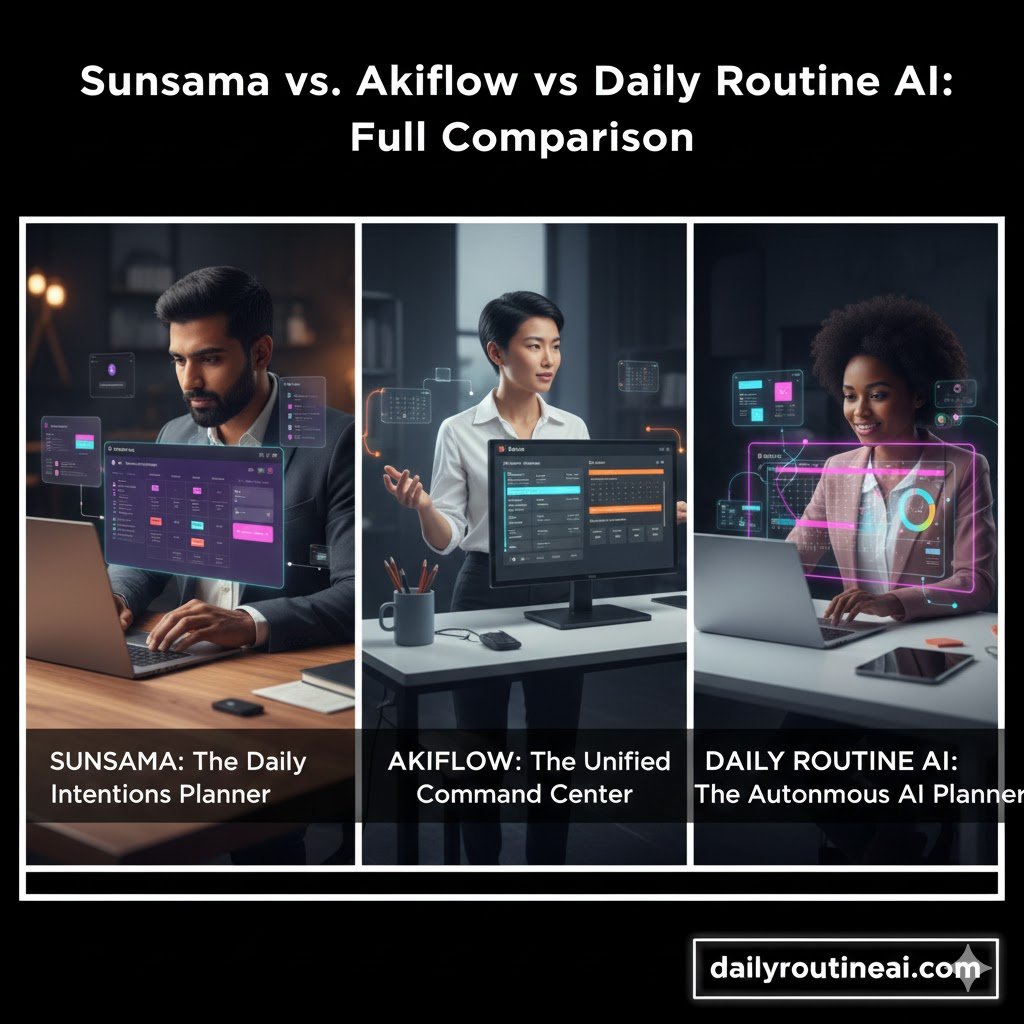
If you’re comparing Sunsama vs. Akiflow vs. Daily Routine AI, the best choice depends on how much structure, automation, and cognitive assistance you need.
Sunsama is best for professionals who value mindful planning, intentional workdays, and human-paced productivity.
Akiflow is ideal for execution-focused users who want a fast, centralized task command center.
Daily Routine AI is designed for users who want adaptive, AI-driven routines that adjust automatically to changing priorities and energy levels.
There is no universal winner.
Each tool solves a different productivity problem.
Why This Comparison Matters in 2026
In 2026, productivity tools are no longer simple task managers. They actively shape how people think, plan, and avoid burnout in AI-driven work environments.
This comparison matters because choosing the wrong system can increase cognitive overload, while the right one can sustainably improve focus, execution, and well-being.
The Shift from Task Managers to AI Productivity Systems
Traditional task managers assumed work was predictable.
Modern work is not.
Today’s professionals operate across fragmented calendars, async communication, global teams, and constant context switching.
AI productivity tools promise relief.
However, not all AI-driven planners solve the same problem.
Some reduce overwhelm.
Others increase execution speed.
A few attempt to think with you rather than for you.
Understanding this distinction is critical before choosing a tool.
Why “One Productivity App” No Longer Works
Work patterns differ dramatically between individuals.
A freelancer managing multiple clients experiences productivity differently than a startup founder or an SEO lead.
Cognitive diversity adds another layer.
Neurodivergent professionals often struggle with rigid systems that assume consistent focus and motivation.
This is where the Sunsama vs. Akiflow vs. Daily Routine AI debate becomes important.
Each tool encodes a different philosophy of work.
Choosing incorrectly can worsen burnout rather than reduce it.
Personal Experience & Editorial Testing Narrative
This comparison is based on hands-on, long-term testing rather than feature lists or marketing claims, using these tools daily across real client work, publishing, and strategic planning.
By observing how Sunsama, Akiflow, and Daily Routine AI perform under pressure, missed deadlines, and burnout cycles, this narrative reveals what actually works in real-world conditions.
How These Tools Were Tested
These tools were tested in live environments, not sandbox scenarios.
They were used for:
- Editorial planning for long-form content
- SEO task execution and sprint planning
- Client management and reporting
- Deep work scheduling and context switching
Each tool was tested continuously for months, not days.
The same workload was mirrored across platforms whenever possible.
This exposed differences in friction, adaptability, and mental fatigue.
The Reality of Daily Use
The first week with any productivity tool feels optimistic.
The real test begins after motivation fades.
Missed days, incomplete tasks, and shifting priorities reveal how forgiving or punishing a system truly is.
Some tools adapt gracefully.
Others collapse under inconsistency.
This distinction became very clear during testing.
Core Philosophy Comparison: How Each Tool Thinks
Each tool is built on a different philosophy of productivity, shaping how users plan, prioritize, and respond to pressure.
Understanding how Sunsama, Akiflow, and Daily Routine AI “think” is critical because their underlying logic directly influences focus, decision-making, and long-term sustainability.
Sunsama’s Mindful Productivity Model
Sunsama is not built for speed.
It is built for intentionality.
The system encourages users to consciously choose tasks for each day.
Nothing is auto-filled without user confirmation.
This design reduces overcommitment.
However, it requires discipline and daily engagement.
Sunsama assumes you want to slow down to speed up.
For many professionals, this feels calming.
For others, it feels restrictive.
Akiflow’s Command-Center Execution Model
Akiflow treats productivity as a logistics problem.
Tasks flow in from everywhere.
Email, Slack, Notion, and other tools feed into a central inbox.
The user’s role is to process, schedule, and execute.
Akiflow prioritizes speed and visibility.
It assumes you already know what needs to be done.
This works exceptionally well for high-output users.
However, it offers little cognitive support when priorities feel unclear.
Daily Routine AI’s Adaptive Intelligence Model
Daily Routine AI approaches productivity as a dynamic system.
Instead of asking you to plan everything manually, it learns patterns over time.
It adapts routines based on task complexity, energy levels, and historical behavior.
This tool is less about task lists and more about behavior shaping.
For users overwhelmed by planning itself, this approach can feel liberating.
Feature-by-Feature Comparison Breakdown
This feature-by-feature breakdown goes beyond surface checklists to evaluate how each tool performs in real workflows, not ideal scenarios.
By comparing planning, automation, execution speed, and cognitive load side by side, it becomes easier to see which tool truly fits different working styles and demands.
Task Capture and Input Speed
Akiflow dominates in raw capture speed.
Its universal inbox allows near-frictionless task intake.
Sunsama is slower by design.
It encourages deliberate task selection rather than rapid accumulation.
Daily Routine AI sits between the two.
It captures tasks efficiently but emphasizes categorization for automation.
AI Planning and Routine Generation
Sunsama uses minimal AI.
Most planning decisions are manual and reflective.
Akiflow offers limited AI assistance.
It focuses more on organization than intelligence.
Daily Routine AI relies heavily on AI.
It generates routines, suggests task sequencing, and adjusts schedules dynamically.
This is where Daily Routine AI clearly differentiates itself.
Calendar Sync and Time Blocking
All three tools support calendar integration.
Sunsama excels at visual time blocking.
It encourages realistic daily capacity planning.
Akiflow offers fast scheduling with drag-and-drop efficiency.
Daily Routine AI uses predictive scheduling.
It adjusts blocks based on completion history and energy patterns.
Focus, Energy, and Burnout Management
Sunsama actively discourages overloading.
It asks users to reflect on the effort and time spent.
Akiflow assumes users self-regulate.
It does not intervene when days become unrealistic.
Daily Routine AI monitors behavioral signals.
It adjusts workloads when burnout patterns emerge.
Sunsama vs. Akiflow vs. Daily Routine AI: Comparison Table
| Feature | Sunsama | Akiflow | Daily Routine AI |
|---|---|---|---|
| Planning Style | Mindful, manual | Fast, execution-first | AI-adaptive |
| Automation Level | Low | Medium | High |
| Cognitive Load | Low | Medium-High | Low |
| Best For | Balance-focused users | Power executors | Overwhelmed planners |
| Neurodivergent Support | Moderate | Limited | Strong |
Deep-Dive Analysis: Strengths and Limitations
This deep-dive analysis examines where each tool genuinely excels and where it falls short under real working conditions.
By understanding the strengths and limitations of Sunsama, Akiflow, and Daily Routine AI, readers can make informed decisions instead of switching tools out of frustration.
Sunsama Strengths
Sunsama excels at reducing emotional overwhelm.
The act of consciously choosing tasks each morning creates psychological ownership.
This improves follow-through for many users.
It also promotes healthy work boundaries.
Overcommitment becomes visually obvious.
Sunsama Limitations
Sunsama can feel slow for high-volume task environments.
Users managing dozens of micro-tasks may find the daily planning ritual exhausting.
It also lacks advanced automation.
Users expecting AI-driven planning may feel disappointed.
Akiflow Strengths
Akiflow shines in execution-heavy roles.
It centralizes tasks beautifully.
Nothing gets lost.
For professionals who already know their priorities, Akiflow accelerates output significantly.
Akiflow Limitations
Akiflow offers little guidance when users feel overwhelmed.
It assumes clarity exists.
When it doesn’t, the system amplifies chaos rather than resolving it.
This is a critical weakness for burnout-prone users.
Daily Routine AI Strengths
Daily Routine AI excels at reducing decision fatigue.
It eliminates the need to plan and re-plan constantly.
Over time, routines feel increasingly personalized.
This creates a sense of momentum without micromanagement.
Daily Routine AI Limitations
The learning phase can feel uncomfortable.
Users who prefer full manual control may distrust AI-driven suggestions.
Occasional misalignment between AI priorities and human intuition can occur.
What I Learned After 12 Months of Testing
After a full year of continuous use, one insight became clear.
Productivity failure is rarely about features.
It is about cognitive mismatch.
Tools succeed when they match how a user thinks under stress.
Sunsama works best during burnout recovery phases.
Akiflow excels during execution sprints.
Daily Routine AI performs best during chaotic, unpredictable periods.
No tool works forever without adjustment.
The most effective users switched tools based on life context, not loyalty.
Realistic Case Study: A Freelance SEO Consultant
This realistic case study follows a freelance SEO consultant managing multiple clients, shifting deadlines, and recurring burnout challenges.
It shows how Sunsama, Akiflow, and Daily Routine AI perform in day-to-day client work, revealing which tool supports sustainable productivity and which ones break under pressure.
Background
A freelance SEO consultant managing 12 clients was tested across all three tools.
The workload included content planning, audits, reporting, and client communication.
Burnout was a recurring issue.
Phase 1: Using Akiflow
Akiflow improved task visibility immediately.
However, the consultant began overloading days.
Execution increased, but stress followed.
Tasks were completed.
Energy was depleted.
Phase 2: Switching to Sunsama
Sunsama reduced daily overwhelm.
The consultant planned fewer tasks and felt more control.
However, administrative work slowed.
Task capture became a bottleneck.
Phase 3: Adopting Daily Routine AI
Daily Routine AI balanced structure and automation.
Routines adjusted based on energy.
Client’s work stabilized.
Burnout incidents decreased noticeably.
Outcome
The consultant now rotates tools.
Akiflow for launch weeks.
Sunsama during recovery.
Daily Routine AI for long-term stability.
Key Takeaways So Far
- There is no universally best productivity tool.
- Cognitive compatibility matters more than features.
- AI-driven planning works best when trust is built gradually.
- The Sunsama vs. Akiflow vs. Daily Routine AI debate is about how you work, not how much you work.
Advanced Edge Cases & Real-World Limitations (2026 Reality)
Modern productivity tools fail not because of missing features, but because real work is messy.
Deadlines move.
Energy fluctuates.
Life interrupts plans.
This section addresses how Sunsama, Akiflow, and Daily Routine AI behave when things go wrong.
Handling Irregular Work Schedules and Time Zone Chaos
Irregular schedules expose the rigidity of productivity systems.
Sunsama struggles here.
Its daily planning ritual assumes predictable working hours.
Akiflow performs better.
Tasks can be rapidly rescheduled, but mental overload increases.
Daily Routine AI adapts best.
It reshapes routines based on availability rather than fixed expectations.
Key takeaway:
AI-driven routines outperform manual planning when schedules change daily.
Over-Automation vs. Decision Fatigue
Automation sounds helpful until control disappears.
Daily Routine AI occasionally over-optimizes.
Users may feel disconnected from decisions.
Sunsama avoids this problem entirely.
Everything requires intentional input.
Akiflow sits in the middle.
Automation exists, but control remains manual.
Rule of thumb:
If you distrust AI suggestions, start manually and layer automation slowly.
AI Misprioritization and Context Loss
AI does not understand emotional urgency.
Daily Routine AI may schedule technically correct tasks that feel psychologically wrong.
This requires human override.
Blind trust creates frustration.
Sunsama avoids this by design.
Akiflow relies on user judgment.
Key takeaway:
AI should assist prioritization, not replace intuition.
Data Privacy and Ethical AI Concerns
All three tools require calendar access.
Some integrate email and task data.
Daily Routine AI collects the most behavioral data.
This enables intelligence but raises privacy questions.
Sunsama collects minimal data.
Akiflow collects operational data only.
Recommendation:
Review permissions quarterly, especially in AI-driven tools.
Troubleshooting Common Productivity Failures
This section addresses the most common productivity pitfalls professionals face, from task rollover to AI misalignment.
By offering practical troubleshooting strategies for Sunsama, Akiflow, and Daily Routine AI, readers can fix issues quickly and maintain consistent workflow efficiency.
“My Days Still Feel Overwhelming”
This usually indicates planning overload.
Fixes:
- Reduce daily task count by 30 percent
- Switch from execution mode to reflection mode
- Use Sunsama-style daily capacity checks
Tasks Keep Rolling Over Every Day
This signals unrealistic estimation.
Fixes:
- Break tasks into completion-based units
- Use Akiflow for capture, Sunsama for commitment
- Let Daily Routine AI re-balance automatically
AI Suggestions Don’t Match My Energy
This is common in early AI usage.
Fixes:
- Manually tag energy levels for one week
- Override AI suggestions without guilt
- Allow the model to relearn patterns
Calendar Conflicts and Sync Errors
Sync issues break trust instantly.
Fixes:
- Designate one “source of truth” calendar
- Avoid double time-blocking across tools
- Audit integrations monthly
When You Should Actually Switch Tools
Switching tools is not a failure.
Staying with the wrong tool is
Switch when:
- Burnout increases despite compliance
- Planning feels heavier than execution
- You resent opening the app
Step-by-Step Implementation Guide (Practical and Technical)
This section shows exactly how to implement each tool correctly, not ideally.
Step-by-Step: Implementing Sunsama Correctly
Best for: Burnout recovery, clarity, intentional work
Week 1 Setup
- Connect the primary calendar only
- Import tasks selectively
- Disable unnecessary integrations
Daily Workflow
- Morning: Select 3–6 tasks only
- Assign realistic time blocks
- End the day with reflection, not completion guilt
Weekly Optimization
- Remove recurring low-value tasks
- Adjust daily capacity downward
- Review effort vs. outcome
Common Mistake:
Treating Sunsama like a task dump.
Step-by-Step: Implementing Akiflow Correctly
Best for: High-volume execution, operations-heavy roles
Week 1 Setup
- Connect all task sources
- Enable quick capture everywhere
- Create processing rules
Daily Workflow
- Process the inbox twice daily
- Schedule tasks immediately
- Execute without revisiting lists
Weekly Optimization
- Archive completed projects
- Remove stale tasks aggressively
- Review execution velocity
Common Mistake:
Using Akiflow without task pruning.
Step-by-Step: Implementing Daily Routine AI Correctly
Best for: Decision fatigue, chaotic schedules, neurodivergent users
Week 1 Setup
- Input core work categories
- Define energy levels honestly
- Allow imperfect routines
Daily Workflow
- Accept AI suggestions initially
- Override when emotionally misaligned
- Mark completes accurately
Weekly Optimization
- Review AI adjustments
- Refine routine categories
- Reduce manual intervention gradually
Common Mistake:
Fighting the AI instead of training it.
Hybrid Stack Strategy (Advanced Users Only)
Many professionals benefit from tool rotation, not tool loyalty.
Recommended Hybrid Stack
- Akiflow → Task capture and execution
- Sunsama → Daily intention and capacity checks
- Daily Routine AI → Long-term rhythm management
Use tools for what they do best.
Avoid forcing one tool to do everything.
Comparative ROI Analysis
| Factor | Sunsama | Akiflow | Daily Routine AI |
|---|---|---|---|
| Setup Time | Low | Medium | Medium |
| Learning Curve | Low | Low | Medium |
| Burnout Reduction | High | Low | High |
| Execution Speed | Medium | High | Medium |
| Long-Term Sustainability | Medium | Medium | High |
Bottom line:
ROI depends on mental energy saved, not tasks completed.
Who Should Use Which Tool (Clear Mapping)
This section maps each tool to the type of professional and workflow it suits best.
By understanding who benefits most from Sunsama, Akiflow, or Daily Routine AI, readers can select the right tool for their cognitive style, workload, and productivity goals.
Choose Sunsama If:
- You feel chronically overwhelmed
- You want work-life boundaries
- You value reflection over speed
Choose Akiflow If:
- You manage many tasks daily
- You already know priorities
- You thrive on execution momentum
If You Choose Daily Routine AI:
- Planning drains you
- Your schedule changes often
- You want AI to adapt with you
Final Verdict: Sunsama vs. Akiflow vs. Daily Routine AI
There is no universal winner.
The best productivity tool is the one that:
- Matches your cognitive style
- Reduces decision fatigue
- Evolves with your life
Sunsama is intentional.
Akiflow is powerful.
Daily Routine AI is adaptive.
Choose accordingly.
Frequently Asked Questions (Voice Search Optimized)
This FAQ section answers the most common questions people ask when comparing Sunsama, Akiflow, and Daily Routine AI.
Written in natural, full-sentence format, it’s optimized for voice search and “People Also Ask,” helping readers get clear, actionable answers quickly.
Is Sunsama better than Akiflow for daily planning?
Yes, Sunsama is better for intentional daily planning, while Akiflow is better for fast task execution and centralized workflows.
How is Daily Routine AI different from other AI planners?
Daily Routine AI adapts routines dynamically based on behavior, energy, and completion history rather than static schedules.
Which productivity tool is best for ADHD or neurodivergent users?
Daily Routine AI generally works best due to adaptive routines, but Sunsama can help during burnout recovery phases.
Can I use Sunsama and Akiflow together?
Yes, many professionals use Akiflow for capture and Sunsama for daily commitment and reflection.
Does Akiflow use artificial intelligence?
Akiflow uses limited automation but does not rely heavily on AI-driven planning or adaptive routines.
Is Daily Routine AI safe to connect with calendars?
Yes, but users should regularly review permissions and understand how behavioral data is processed.
Which tool reduces burnout the most?
Sunsama and Daily Routine AI both reduce burnout, but through different mechanisms.
Are AI productivity tools worth it in 2026?
Yes, especially for professionals managing cognitive overload and unpredictable schedules.
Can these tools replace project management software?
No, they complement project management tools rather than replace them.
Which tool works best for remote and async work?
Daily Routine AI performs best due to adaptive scheduling across time zones and async workflows.
Final Key Takeaways
- Productivity tools fail when they ignore cognition
- AI works best when trained, not obeyed
- Tool switching is strategic, not weak
- Sunsama vs. Akiflow vs. Daily Routine AI is about mindset, not features