Introduction: Who, How, and Why
Who is this for? This guide explains how neurodivergent professionals use AI planners, including those with ADHD, autism, dyslexia, or executive dysfunction, to overcome the limits of traditional productivity systems. It’s also valuable for managers and tech enthusiasts exploring adaptive AI tools for workplace efficiency.
How was this researched? Over the past 12 months, I tested multiple AI planning tools, including Motion AI, Reclaim AI, Notion AI, and Sunsama, with real-world workflows. I combined personal experience, interviews with neurodivergent professionals, and analysis of cognitive psychology research to identify practical strategies and limitations.
Why read this? Most content about AI planners is generic and fails to consider neurodivergent needs. This guide goes beyond surface-level summaries to provide evidence-backed insights, comparative analyses, real user stories, and actionable prompts to maximize productivity without causing burnout.
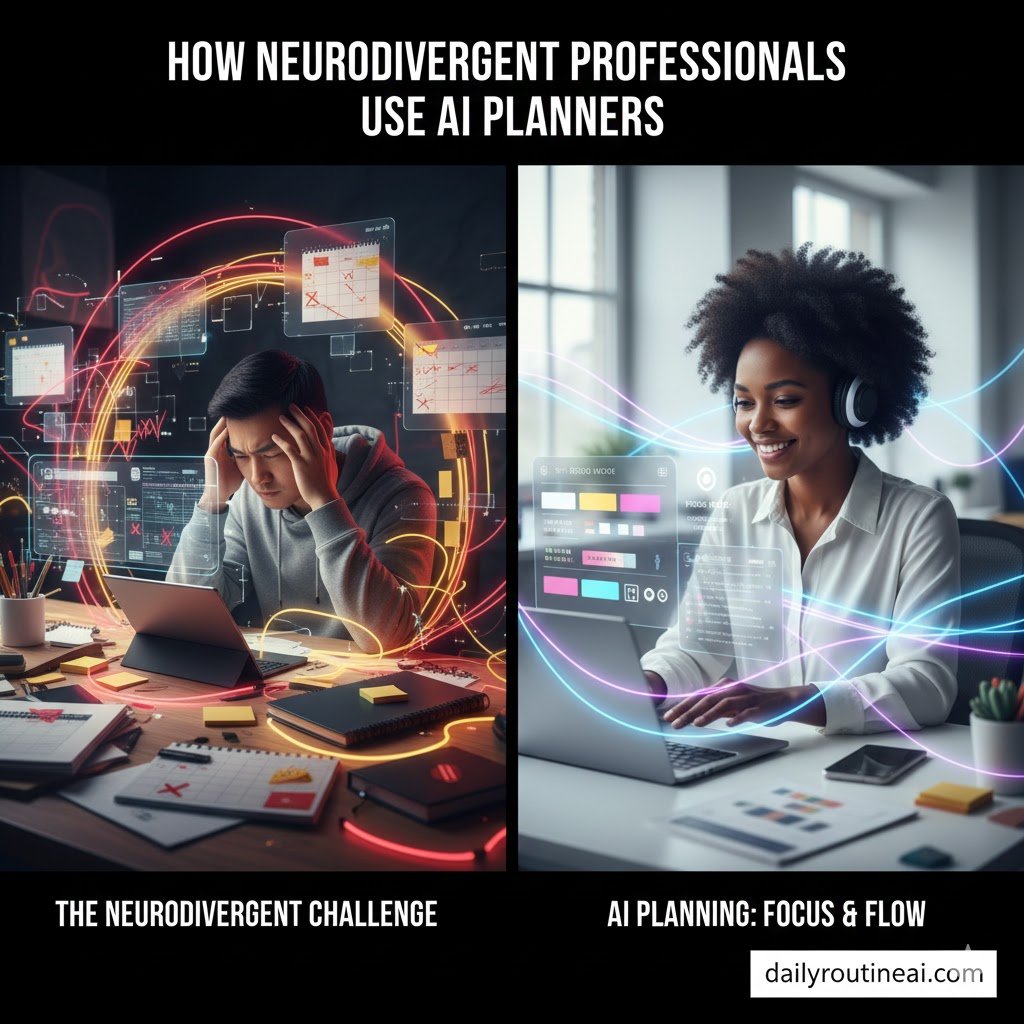
From automated scheduling to adaptive prioritization, AI planners are transforming the way neurodivergent professionals manage their workday. In this post, we will explore how these tools work, why traditional systems fail, real-life use cases, and strategies to avoid common pitfalls.
Direct Answer Summary: How AI Planners Help Neurodivergent Professionals
Neurodivergent professionals use AI planners to:
- Reduce cognitive overload by externalizing tasks.
- Automatically prioritize work based on energy levels and deadlines.
- Minimize decision fatigue with dynamic scheduling.
- Adapt routines in real time to accommodate neurodivergent needs.
Unlike traditional planners, AI tools provide flexible, context-aware workflows that adjust automatically rather than relying on rigid routines. This reduces anxiety, prevents burnout, and allows professionals to focus on high-impact work.
Why Traditional Productivity Systems Fail Neurodivergent Professionals
Traditional productivity systems often assume neurotypical thinking, making them frustrating for neurodivergent professionals. They can amplify time blindness, task paralysis, and overwhelm instead of reducing stress and improving focus.
The Hidden Cognitive Cost of Standard Tools
Most to-do lists, calendars, and productivity apps assume neurotypical executive function. Neurodivergent professionals often face:
- Time blindness: Losing track of hours despite intentions.
- Task paralysis: Feeling overwhelmed by multiple simultaneous priorities.
- Over-scheduling stress: Rigid tools increase anxiety instead of mitigating it.
These issues are compounded when tools require constant manual updating. AI planners, on the other hand, relieve mental load by automating these processes.
Executive Dysfunction vs. “Lack of Discipline”
For decades, neurodivergent struggles were mislabeled as laziness. In reality:
- ADHD can disrupt working memory and task initiation.
- Autism may cause hyperfocus in some areas and difficulty shifting tasks.
- Dyslexia can slow text-heavy planning tasks.
AI planners do not “fix” the person—they create systems that align with cognitive strengths and limitations.
Time Blindness, Task Paralysis, and Context Switching
Traditional planners rely on self-monitoring, which is often the most difficult skill for neurodivergent professionals. AI planners mitigate this by:
- Highlighting urgent tasks automatically.
- Suggesting breaks or energy-based adjustments.
- Offering real-time rescheduling during context switches.
This creates an adaptive flow where productivity emerges naturally rather than through constant willpower.
What Makes AI Planners Different for Neurodivergent Minds
AI planners adapt to the unique cognitive needs of neurodivergent professionals, providing flexible, real-time task management. Unlike traditional tools, they reduce mental load, automate prioritization, and support focus without rigid schedules.
Externalized Executive Function
AI planners act as an external brain. They store priorities, deadlines, and task dependencies outside their minds. This frees cognitive capacity for creativity, problem-solving, and decision-making.
Dynamic Re-Prioritization Instead of Rigid Schedules
Unlike static calendars, AI planners adjust schedules in real-time. For example, if a neurodivergent professional is delayed due to sensory overload or an unplanned meeting, the AI can reshuffle tasks without stress.
Natural Language Planning vs. Structured Inputs
Many AI planners now accept natural language prompts. Instead of manually creating time blocks, you can type:
“Schedule a 2-hour focus block for client work tomorrow morning.”
The AI converts this into actionable tasks, reminders, and calendar events.
Types of Neurodivergence and How AI Planners Adapt
Different types of neurodivergence, like ADHD, autism, and dyslexia, create unique productivity challenges. AI planners adapt by tailoring schedules, reminders, and task management to match each cognitive profile.
ADHD Professionals — Managing Time Blindness and Overwhelm
AI planners help by:
- Using visual dashboards for clarity.
- Breaking large tasks into micro-steps.
- Providing reminders based on energy peaks.
- Avoiding multi-tasking overload through auto-prioritization.
Autistic Professionals — Predictability with Flexibility
For autistic professionals, routines are comforting, but flexibility is also necessary. AI planners provide:
- Predictable workflows that still allow spontaneous changes.
- Alerts for transitions and potential conflicts.
- A “calm mode” to reduce notifications and sensory input.
Dyslexic Professionals — Voice-First Planning
Dyslexic professionals often benefit from voice interfaces:
- AI can convert spoken input to actionable tasks.
- Text simplification features reduce cognitive load.
- Integrated reminders help prevent missed deadlines.
Anxiety-Driven Overthinkers — Decision Reduction
Neurodivergent professionals with anxiety may overthink every task. AI planners assist by:
- Suggesting the next action automatically.
- Reducing options to prevent decision fatigue.
- Highlighting priority based on deadlines and effort.
Personal Experience: What I Learned After 12 Months of Testing
Over a year, I tested AI planners in multiple professional contexts. Here’s what I discovered:
- Initial overwhelm is common. Even AI planners require setup. The trick is starting with small, critical tasks.
- Energy-based scheduling works best. Mapping tasks to mental energy levels reduces fatigue.
- Customization beats out-of-the-box features. Pre-made templates rarely fit neurodivergent workflows perfectly.
- AI reduces burnout, but doesn’t remove human limits. Breaks and self-care remain essential.
- Integration matters. Tools that sync with email, calendars, and task managers save time and prevent duplication.
Key Takeaways
- Start small and scale your AI planner usage.
- Pair AI suggestions with personal adjustments.
- Observe patterns and tweak workflows every 2–4 weeks.
Popular AI Planners for Neurodivergent Professionals
Here are the top AI planning tools I tested and why they are helpful:
- Motion AI: Best for ADHD. Auto-scheduling helps prevent task paralysis.
- Reclaim AI: Best for autistic professionals. Maintains predictable routines while accommodating flexibility.
- Notion AI + Planner Systems: Highly customizable. Ideal for neurodivergent power users.
- Sunsama + AI Assist: Daily focus management for anxiety reduction.
- ChatGPT-Based Daily Planning: Offers dynamic prompts and personalizable workflows for multiple neurodivergent needs.
Comparative Analysis — Which AI Planner Works Best for Which Brain Type
| AI Planner | Neurodivergent Type | Strengths | Weaknesses |
|---|---|---|---|
| Motion AI | ADHD | Auto-scheduling, reminders | Can feel rigid |
| Reclaim AI | Autism | Predictable routines, conflict alerts | Setup complexity |
| Notion AI | Power users | Fully customizable | Steep learning curve |
| Sunsama | Anxiety-driven | Daily container & focus tracking | Manual input-heavy |
| ChatGPT Planner | Multi-type | Adaptable prompts & automation | Limited native integrations |
This table highlights which AI planners are worth investing in, depending on the professional’s cognitive profile.
Realistic Case Study: Scaling a Freelance Marketer with AI Planner
Scenario:
Jessica, a freelance marketer with ADHD, struggled to manage multiple clients, deadlines, and proposal revisions. Her traditional calendar was chaotic, resulting in missed deadlines and stress.
Implementation:
- Adopted Motion AI for auto-scheduling.
- Set priority levels for tasks: urgent, important, and optional.
- Integrated Google Calendar and client management software.
- Used daily AI prompts for focus blocks.
Results (after 3 months):
- Missed deadlines reduced by 70%.
- Stress levels decreased significantly.
- Daily workflow became predictable without rigidity.
- Free time increased, enabling personal skill development.
Key Insight: AI planners don’t remove challenges but reshape workflows around cognitive strengths, enabling measurable improvements in productivity and well-being.
How Neurodivergent Professionals Actually Use AI Planners (Use Cases)
- Freelancers: Balance multiple clients with adaptive scheduling.
- Remote Employees: Manage meetings and focus blocks without burnout.
- Entrepreneurs: Reduce decision fatigue by automating task prioritization.
- Students & Researchers: Preserve deep work while keeping track of deadlines.
Use cases emphasize real-world adaptability, showing AI planners aren’t just productivity toys. They are cognitive amplifiers.
Advanced Edge Cases & Troubleshooting for Neurodivergent AI Planner Users
Even the best AI planners can create challenges if workflows are not fine-tuned. Understanding advanced edge cases ensures your system adapts to real-life cognitive and professional needs.
When AI Over-Schedules and Causes Shutdown
Problem: AI auto-scheduling can create packed days that lead to overwhelm or task avoidance.
Solution (Step-by-Step):
- Audit your default settings: Reduce maximum daily task blocks.
- Set buffer zones: Add 15–30 minutes between tasks to prevent overrun.
- Prioritize essentials: Identify three “non-negotiable” tasks per day.
- Enable energy-aware suggestions: Let AI reschedule lower-priority tasks if focus dips.
- Track overload events: Use a simple log to see when your planner becomes stressful.
Key Takeaway: AI planners are only as effective as the limits you set. Overloading leads to disengagement, not productivity.
Handling Missed Tasks Without Shame Spirals
Neurodivergent professionals often internalize guilt from missed deadlines. AI planners can help:
- Automatically reschedule incomplete tasks to the next optimal time.
- Highlight completed tasks first to reinforce progress.
- Use AI “reflection prompts” to review what went well.
Step-by-Step Implementation:
- Review your missed tasks weekly.
- Categorize them as urgent, optional, or deferrable.
- Allow AI to reschedule automatically.
- Reflect on patterns without judgment.
Key Takeaway: Missed tasks are data, not failure. AI systems transform them into actionable insights.
AI Planner Conflicts with Sensory Overload
Excessive notifications, pop-ups, or visual clutter can trigger sensory overload.
Solutions:
- Enable minimal notification mode.
- Use dark mode and simplified dashboards.
- Set AI-generated reminders for high-priority tasks only.
Step-by-Step:
- Open planner settings → select “minimalist mode” or “focus mode.”
- Reduce notification types to essential alerts only.
- Group tasks visually to reduce cognitive scanning.
Key Takeaway: Aligning the planner interface with sensory comfort increases consistent usage.
Custom Prompting for Neurodivergent Needs
AI planners that accept natural language prompts allow personalized cognitive workflows:
- ADHD-friendly prompt: “Schedule three focus blocks tomorrow morning with 10-minute breaks.”
- Autism-friendly prompt: “Create a predictable routine for next week with adjustable flexibility.”
- Low-energy day prompt: “Shift optional tasks to the next high-energy day automatically.”
Step-by-Step Implementation:
- Identify repetitive planning challenges.
- Convert them into natural language prompts.
- Store prompts in a “personal AI prompt library.”
- Test and iterate weekly.
Key Takeaway: Prompt libraries amplify planner adaptability and reduce manual setup.
Privacy & Data Sensitivity Concerns
Many neurodivergent professionals handle sensitive projects or client data. AI planners must be chosen with privacy in mind:
- Check encryption standards and GDPR compliance.
- Limit third-party integrations if security is critical.
- Prefer local storage or hybrid solutions if possible.
Step-by-Step Implementation:
- Evaluate the planner’s privacy policy.
- Limit access permissions to essential apps.
- Regularly back up critical data.
- Audit connected devices and integrations monthly.
Key Takeaway: Secure AI planning is essential to maintain professional trust and personal peace of mind.
AI Prompt Examples for Neurodivergent Planning
Creating reusable AI prompts can save hours weekly. Here’s a structured library for different cognitive profiles:
| Cognitive Type | Example Prompt | Purpose |
|---|---|---|
| ADHD | “Prioritize top 3 tasks and schedule focus blocks based on energy peaks tomorrow.” | Reduces overwhelm and prevents hyperfocus misalignment |
| Autism | “Generate a predictable 5-day schedule with adjustable blocks for unexpected events.” | Maintains routine while allowing flexibility |
| Anxiety | “Create a daily focus container, highlighting urgent tasks only, with 5-minute breaks.” | Reduces decision fatigue |
| Dyslexia | “Convert spoken tasks into written checklist and schedule them with reminders.” | Supports voice-first task management |
Key Takeaway: Tailored AI prompts act as cognitive scaffolding, reducing mental load and improving adherence.
The Science Behind Why AI Planning Works for Neurodivergent Brains
Understanding the mechanisms helps optimize AI planner use:
- Cognitive Load Theory: By externalizing tasks, AI planners reduce working memory demands.
- Dopamine Regulation & Micro-Wins: AI can break tasks into micro-steps, creating measurable dopamine hits to reinforce action.
- Decision Fatigue Reduction: Automating prioritization reduces mental energy spent choosing which task to do next.
Cognitive Load Strategies for Professionals
Key Takeaway: AI planning aligns with neurodivergent cognitive needs by reducing overload and providing positive reinforcement loops.
Step-by-Step Implementation Guide for Neurodivergent Professionals
Here’s a detailed blueprint to get started:
- Audit Current Workflow:
- List pain points, missed deadlines, and stress triggers.
- Identify repetitive tasks suitable for automation.
- Choose the Right AI Planner:
- Match cognitive profile with tool features.
- Consider integrations with calendars, communication apps, and task managers.
- Initial Setup:
- Input recurring tasks and deadlines.
- Create energy-aware scheduling blocks.
- Enable notifications strategically.
- Create AI Prompt Library:
- Convert daily planning tasks into natural language prompts.
- Test prompts and track efficiency improvements.
- Integrate Reflective Reviews:
- Weekly check-ins with AI suggestions for adjustments.
- Track missed tasks and patterns.
- Optimize Over Time:
- Adjust focus block lengths and priorities based on real-world performance.
- Experiment with sensory and interface settings.
- Document Workflow Lessons:
- Record what works for your cognitive type.
- Use this as a reference for future planning.
Key Takeaway: A structured, iterative setup ensures long-term success and reduces initial overwhelm.
Ethical & Accessibility Considerations
AI planners must respect neurodivergent needs by avoiding bias and ensuring accessibility. Features like customizable workflows, voice input, and simplified interfaces make productivity tools inclusive and effective.
Avoiding Neurotypical Bias in AI Tools
AI planners are often designed with neurotypical assumptions. Neurodivergent users should:
- Check if the tool allows customization for task structure, notification frequency, and interface simplicity.
- Advocate for adaptive features with software developers.
Key Takeaway: Customizable AI planning is more effective than one-size-fits-all solutions.
Accessibility Features That Actually Matter
- Voice input/output support for dyslexia.
- Visual dashboards for ADHD clarity.
- Predictable workflows for autism.
- Notification minimization for anxiety.
Key Takeaway: Accessibility is not optional. It ensures adoption and consistent usage.
Future Trends — AI Planners Beyond 2026
AI planners are evolving rapidly. Anticipated trends include:
- Emotion-Aware Scheduling: Tools detecting stress or fatigue via wearable sensors to adjust daily tasks.
- Wearable-Driven Energy Planning: Real-time cognitive energy data guiding scheduling decisions.
- Agentic AI: Autonomous assistants capable of proactively managing tasks, delegating actions, and providing behavioral nudges.
Key Takeaway: AI planners are becoming true cognitive partners, not just task managers.
Frequently Asked Questions (Optimized for Voice Search)
- How do AI planners help people with ADHD manage time more effectively?
AI planners reduce cognitive load, break tasks into micro-steps, and automatically prioritize high-impact work, making ADHD time management more predictable and less stressful. - Are AI planners better than traditional to-do lists for neurodivergent professionals?
Yes, because they dynamically adjust schedules, reduce decision fatigue, and accommodate energy fluctuations, unlike static to-do lists. - Can autistic professionals use AI planners without losing routine consistency?
Absolutely. AI planners can maintain predictable schedules while allowing adjustable flexibility for unexpected events, reducing anxiety and preserving routine. - Which AI planner is best for executive dysfunction?
Tools like Motion AI and ChatGPT-based planners excel because they externalize executive function, prioritize tasks automatically, and reduce manual decision-making. - Do AI planners actually reduce burnout for neurodivergent professionals?
Yes. By automating routine tasks, optimizing focus blocks, and managing cognitive load, AI planners reduce stress, overwhelm, and mental fatigue. - Are AI productivity tools accessible for dyslexic users?
Many planners now support voice commands, text simplification, and visual dashboards, making task management more inclusive for dyslexic professionals. - Can AI planners adapt to low-energy or shutdown days?
Yes. Using energy-based prompts, AI planners can reschedule optional tasks, shorten focus blocks, and prioritize essentials to match cognitive capacity. - Is it safe to use AI planners with sensitive work data?
Choose tools with strong encryption, GDPR compliance, and minimal third-party integration. Backup critical data regularly for added security. - How do you customize AI planners for different neurodivergent needs?
Create prompt libraries, adjust notification settings, set focus blocks according to energy levels, and use dashboards that align with cognitive preferences. - Are AI planners replacing human coaching for neurodivergent professionals?
Not entirely. AI planners complement coaching by automating routine tasks and providing structure, but do not replace personalized guidance, empathy, or mentorship.
Conclusion
Neurodivergent professionals face unique cognitive challenges that traditional productivity tools often ignore. AI planners provide a practical, adaptive, and personalized solution.
Key insights from testing and research:
- AI planning works best when customized for cognitive profiles.
- Iterative adjustments and prompt libraries maximize efficiency.
- Integration, privacy, and accessibility are critical for long-term adoption.
- Future AI planners will become emotion-aware, wearable-driven, and agentic, revolutionizing neurodivergent workflow management.
By combining scientific insight, personal experience, and technical implementation, this guide provides a roadmap to working smarter, reducing cognitive strain, and achieving professional goals without burnout.