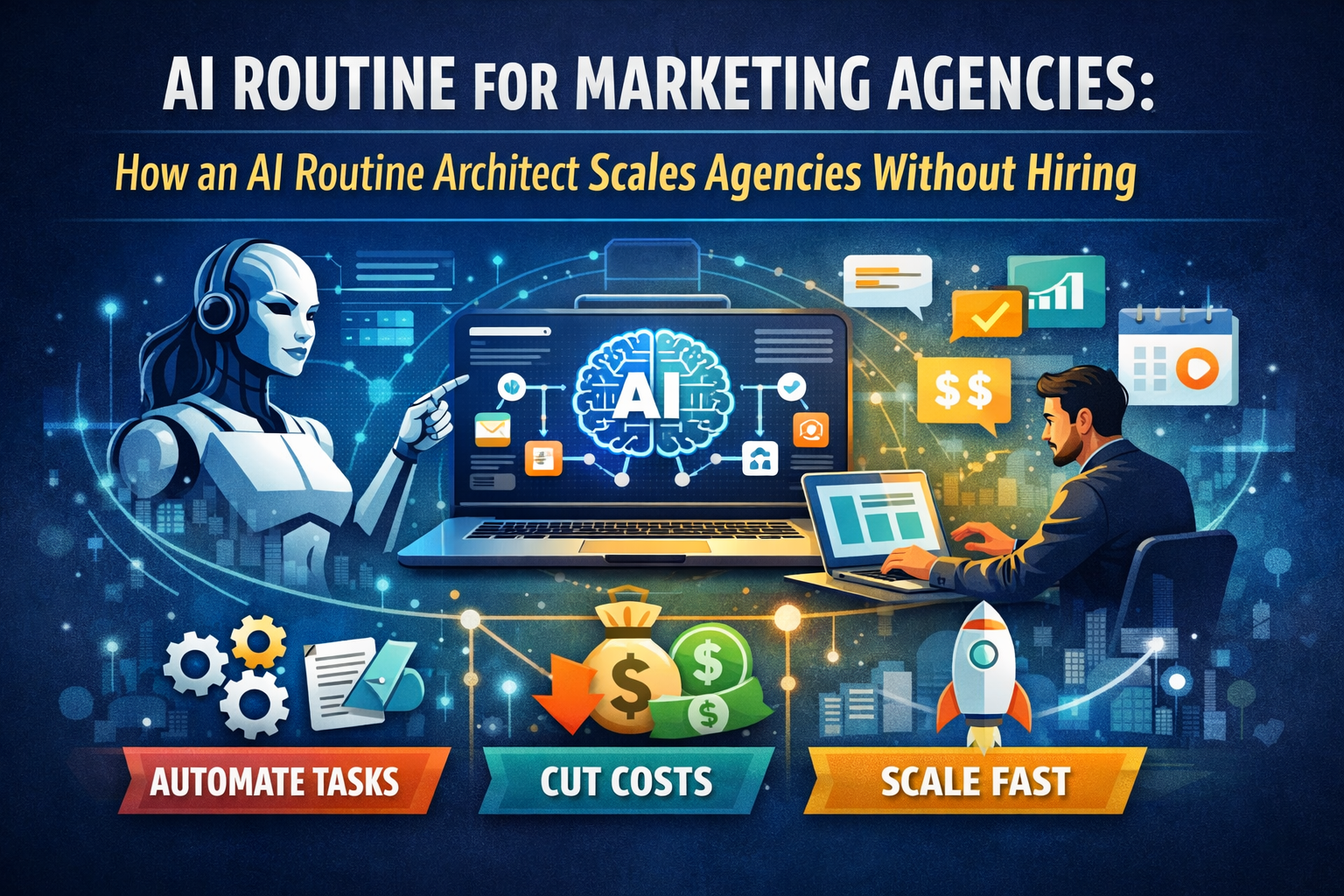
Scaling a modern agency no longer depends on hiring faster or working longer hours. It depends on how intelligently the work is systematized. An AI routine for marketing agencies is emerging as the operating backbone, replacing repetitive execution with automated intelligence, allowing agencies to grow revenue without inflating headcount or sacrificing quality.
Direct Answer — What Is an AI Routine for Marketing Agencies? (AI Overview Target)
An AI routine is a structured, automated workflow that uses artificial intelligence to handle repetitive agency tasks. Instead of relying on manual execution, agencies deploy connected AI processes to deliver work faster, reduce operational costs, and maintain consistent output across clients at scale.
Who This Is For (Agencies That Benefit Most)
This approach is designed for SEO agencies managing large content pipelines, performance marketing teams handling frequent reporting cycles, content studios producing at volume, and boutique consultancies aiming to scale without bloated teams. It is especially powerful for freelancers transitioning into full-service agencies who need leverage early.
Why Traditional Agency Operations Stop Scaling
The Hidden Cost of Manual Campaign Execution. Manual execution drains agencies in ways that are rarely tracked. Time leaks through repetitive reporting, constant context switching, and duplicated effort across clients. Human error creeps into data handling and content workflows, while creative teams lose focus, jumping between tools, briefs, and communication threads.
Over time, these inefficiencies compound. Delivery slows, margins shrink, and leadership spends more time managing chaos than building strategy.
Bottlenecks That Kill Agency Margins
Hiring is slow and expensive, yet often becomes the default response to growth. Onboarding new staff takes weeks, sometimes months, before productivity stabilizes. Inconsistent SOPs lead to uneven quality, while burnout increases as teams attempt to keep pace with expanding client demands.
These bottlenecks cap growth long before market demand runs out.
What Is an AI Routine Architect? (Core Concept Explanation)
An AI Routine Architect is the system that connects AI tools into structured, rule-based workflows that automate your agency operations.
Instead of isolated automation, it creates AI-powered workflow automation systems that are scalable, repeatable, and deliver consistent results across every client.
AI Routine vs Single AI Tool
A single AI tool solves a narrow problem. It writes copy, generates ideas, or summarizes data in isolation. An AI routine architect, however, designs connected workflows where multiple AI actions operate together under defined rules.
This distinction matters. Tools assist individuals, while routines scale organizations. An AI routine for marketing agencies is about orchestration, not experimentation.
Core Components of an AI Routine Architecture
Every effective AI routine is built on five elements. Triggers initiate the workflow based on time, events, or inputs. Data sources feed the system with context. Decision layers apply logic and constraints. Outputs generate usable assets or insights. Feedback loops refine performance over time.
When these components work together, the system improves with use rather than degrading.
Key Agency Functions That Can Be Automated with AI Routines
AI routines automate the most time-consuming agency functions, from lead qualification and content workflows to reporting and performance analysis.
This allows teams to focus on strategy and growth while systems handle execution with speed and consistency.
AI Routines for Lead Generation & Qualification (AI routine for marketing agencies)
AI routines can filter inbound leads, enrich contact data, and automatically score prospects. Instead of manual review, qualified leads are routed to the right pipeline, while unfit inquiries are filtered out. CRM records update in real time, keeping sales teams focused only on high-intent opportunities.
This reduces response time and improves close rates without additional staff.
AI Routines for Content & SEO Operations
Content workflows are ideal for automation. AI routines can cluster keywords, generate SEO briefs, draft content outlines, optimize on-page elements, and flag outdated pages for refresh. Editors step in at strategic checkpoints rather than managing every stage manually.
The result is faster production with consistent SEO standards across all clients.
AI Routines for Paid Ads & Performance Marketing
In paid media, AI routines generate multiple ad copy variants, analyze performance patterns, and surface budget pacing insights. Weekly and monthly summaries are produced automatically, allowing strategists to focus on optimization decisions rather than data assembly.
This shortens feedback cycles and improves campaign agility.
AI Routines for Client Reporting & Communication
Client communication often consumes more time than execution. AI routines can power live dashboards, auto-generate weekly summaries, and trigger proactive alerts when performance shifts. Clients receive timely, structured updates without waiting for manual reports.
For agencies, this improves transparency while reducing reporting overhead tied to an AI routine for marketing agencies strategy.
Personal Experience — How Agencies Actually Scale Using AI Routines
Scaling looks clean in theory, but in reality, it is messy. Before adopting an AI routine for marketing agencies, most teams believe they are efficient simply because work gets done. In practice, growth exposes every hidden weakness in execution, communication, and quality control. This section reflects what actually happens inside agencies before and after systemization.
Life Before AI Routines (Manual Chaos)
Before AI routines, turnaround times depended heavily on specific people. If a strategist was unavailable, work slowed instantly. Reporting deadlines slipped, content quality varied, and clients felt the inconsistency even when results were acceptable.
Teams spent more time coordinating work than doing high-impact tasks. Every new client added pressure rather than leverage.
The First AI Routine That Changed Everything (AI routine for marketing agencies)
The turning point usually starts small. For many agencies, the first win comes from automating weekly reporting and performance summaries. Once deployed, reporting time drops from hours to minutes, and errors almost disappear.
That single routine creates clarity. Teams suddenly trust their data and regain time for strategy, not spreadsheets.
Results After Systemizing the Agency with AI
After systemization, delivery becomes predictable. Turnaround times shrink, margins improve, and client retention increases because communication is consistent. Most importantly, growth no longer feels fragile.
Instead of reacting to workload spikes, agencies operate with control and confidence.
AI Routine Architecture Framework for Marketing Agencies
Building AI routines without a framework leads to fragile systems. Architecture matters more than tools. A well-designed AI routine for marketing agencies starts with clarity, not automation.
Strong frameworks reduce complexity while increasing scalability across teams and clients.
Step 1 — Audit Repetitive Agency Tasks
The process begins by identifying tasks repeated weekly or monthly across departments. Reporting, content briefs, lead qualification, and performance summaries usually surface quickly.
If a task follows a pattern, it is a candidate for automation.
Step 2 — Define Inputs, Outputs, and Success Metrics
Before building anything, workflows must be mapped clearly. Inputs define what data enters the system. Outputs define what usable result comes out. Metrics define whether the routine actually improves performance.
Skipping this step creates automation that looks impressive but delivers little value.
Step 3 — Build Modular, Reusable AI Routines
The most scalable routines are modular. They can be reused across clients with minimal adjustments. This allows agencies to onboard new clients without rebuilding systems from scratch.
Modularity turns growth into multiplication, not repetition.
Comparative Analysis — AI Routine Agencies vs Traditional Agencies
The difference between AI-driven and traditional agencies becomes obvious when viewed operationally. Systems outperform hero-based execution every time.
Below is how both models compare in real-world conditions.
Operational Efficiency Comparison Table
| Factor | Traditional Agency | AI Routine Agency |
|---|---|---|
| Turnaround Time | Slow, people-dependent | Fast, system-driven |
| Error Rate | Moderate to high | Low and controlled |
| Output Consistency | Varies by team member | Standardized |
| Scalability | Linear | Exponential |
Cost Structure & Profit Margin Breakdown
Traditional agencies scale by hiring, which increases fixed costs quickly. AI routine agencies scale by leveraging. Overhead grows slowly while output expands faster.
This gap directly increases profit margins without sacrificing delivery quality.
Client Experience & Retention Impact
Clients value clarity more than complexity. AI-powered agencies deliver predictable updates, faster insights, and proactive communication. This builds trust and reduces churn.
Retention improves because clients feel informed, not managed.
Advanced Use Cases & Edge Scenarios
Once core routines are stable, agencies face more complex challenges. Advanced use cases test whether the architecture was designed correctly from the start.
This is where mature AI routine for marketing agencies setups stand apart.
Managing Multiple Clients with Different SOPs
Different clients require different rules, not different systems. The solution lies in configurable logic layers that adapt workflows without rebuilding routines.
This keeps operations clean while preserving flexibility.
AI Hallucinations & Quality Control Systems
AI outputs must be validated. Human-in-the-loop checkpoints, rule-based constraints, and source validation reduce hallucinations significantly.
Quality control is not removed; it is repositioned.
Scaling Without Losing Brand Voice or Strategy
Consistency does not mean uniformity. Brand guidelines, tone constraints, and strategic inputs ensure AI outputs align with each client’s identity.
AI scales execution, not decision-making.
Troubleshooting Common AI Routine Failures
Failures usually stem from design flaws, not technology limits. Most issues are predictable and fixable with proper diagnostics.
When AI Outputs Become Generic or Repetitive
This happens when inputs lack specificity. Improving prompts, adding context layers, and refining constraints restores originality quickly.
Specific inputs create specific outputs.
Data Dependency & Garbage-In Problems
Poor data leads to poor automation. Inconsistent naming, outdated sources, or missing fields break workflows silently.
Cleaning inputs is often the fastest performance upgrade.
Team Resistance & Adoption Challenges
Resistance is natural. Teams fear replacement or loss of control. Clear communication, training, and showing time savings reduces friction.
When teams see AI as support, adoption accelerates.
Security, Ethics & Client Trust in AI-Driven Agencies
As agencies scale, trust becomes the real currency. Any AI routine for marketing agencies must be built with security and ethics at its core, not added later as a patch. Clients may accept automation, but they will never compromise on data safety, transparency, or responsible use.
Strong systems protect both growth and reputation.
Client Data Privacy Considerations
Client data flows through multiple tools, dashboards, and reports. That makes access control critical. AI routines must follow strict permission rules, encrypt sensitive data, and log every action for accountability.
Transparency matters just as much. Clients should understand how their data is used, stored, and protected inside systems like Routine Architect, not treated as a black box.
Ethical AI Use in Marketing Automation (AI routine for marketing agencies)
Ethical AI avoids manipulation, misinformation, and blind automation. AI routines should enhance decision-making, not exploit audiences or inflate metrics artificially.
Clear boundaries, human oversight, and ethical guidelines ensure automation supports long-term brand trust rather than short-term gains.
Future of AI Routines in Marketing Agencies
AI routines are evolving quickly. What started as task automation is moving toward systems that understand goals, adjust strategies, and execute with minimal intervention.
Agencies that prepare early will shape this future instead of reacting to it.
From Task Automation to Autonomous Campaign Management
The next phase is semi-autonomous execution. AI systems will plan content calendars, adjust ad spend, and optimize campaigns based on performance signals.
Tools like Routine Architect are already laying the groundwork by connecting workflows into intelligent systems rather than isolated automations.
How Early Adoption Creates a Competitive Moat
Early adopters build internal leverage that competitors cannot copy overnight. SOPs become systems, and systems become advantages.
An AI routine for marketing agencies compounds over time, making late entry increasingly expensive and difficult.
Frequently Asked Questions About AI Routine for Marketing Agencies
Get clear, expert-backed answers to the most common questions about the AI routine for marketing agencies and how it actually scales growth.
Cut through the hype and discover what works, what doesn’t, and what gives agencies a true competitive edge.
What is an AI routine for a marketing agency?
An AI routine is a structured workflow where AI automates repetitive agency tasks such as reporting, content operations, lead qualification, and performance analysis under defined rules.
How do AI routines help agencies scale faster?
They remove manual bottlenecks, reduce dependency on hiring, and ensure consistent delivery, allowing agencies to handle more clients without increasing overhead.
Are AI routines better than hiring more staff?
In most cases, yes. AI routines scale output without adding fixed costs, while hiring increases complexity, onboarding time, and long-term expenses.
Can small agencies use AI routine architecture?
Absolutely. Smaller agencies benefit even more because AI routines provide leverage early, allowing them to compete with larger firms.
What agency tasks should be automated first?
Reporting, data analysis, content briefs, lead qualification, and recurring communication are the best starting points.
Do AI routines replace marketers or support them?
They support marketers. Strategy, creativity, and judgment remain human-led, while AI handles execution-heavy tasks.
How much does it cost to implement AI routines?
Costs vary by complexity, but tools like Routine Architect reduce implementation time and expense by providing a structured foundation.
Are AI routines safe for client data?
Yes, when built correctly. Secure access controls, encryption, and compliance standards are essential components.
How long does it take to build an AI routine system?
Basic routines can be learned within days. Full agency-wide systems usually take a few weeks to mature.
Can AI routines work across SEO, ads, and content?
Yes. Unified routines can connect SEO, paid ads, and content workflows into a single operating system.
Final Takeaway — Building an AI-First Agency Operating System
The agencies that win in the next decade will not be the busiest. They will be the most systematized.
Why AI Routines Are the New Agency Infrastructure (AI routine for marketing agencies)
AI routines are no longer optional optimizations. They are foundational infrastructure. Agencies that adopt platforms like Routine Architect move from reactive execution to scalable control.
This shift future-proofs operations, protects margins, and positions agencies to grow without limits.