
You create a daily schedule, organize your priorities, and promise yourself that this time will be different. For a few days, everything seems manageable. Then a meeting runs late, you wake up tired, an unexpected responsibility appears, or you miss one of your planned habits.
Suddenly, your entire routine feels impossible to follow.
If this sounds familiar, you may be asking, “Why can’t I stick to a routine?”
The answer isn’t necessarily that you lack discipline. Sometimes, the routine itself demands too much time, assumes every day will go as planned, or leaves no room to recover when something changes.
A useful routine should help you manage real life—not require real life to follow a perfect schedule.
In this guide, you’ll learn why routines often fall apart, how to create a flexible daily schedule, and how to get back on track without starting over every Monday.
Why Can’t I Stick to a Routine?
No single explanation applies to everyone. However, several common planning problems can make a routine difficult to maintain.
1. You designed your routine for your best day
When motivation is high, it’s easy to plan an ambitious morning: wake up early, exercise, prepare breakfast, journal, read, and begin work ahead of schedule.
The problem appears when your normal responsibilities compete with that plan.
A routine that only works when you sleep well, have plenty of time, and face no interruptions may be too demanding for everyday life.
What to do instead: Build your routine around what you can reasonably repeat on an ordinary day. Start with one or two important habits before adding more.
2. You try to change everything at once
Changing your wake-up time, diet, exercise, work habits, screen time, and bedtime simultaneously creates a long list of new behaviors to manage.
Each change requires planning and follow-through. Trying to introduce too many changes at once can make the entire routine feel overwhelming.
What to do instead: Choose one priority to establish first. Once it fits reasonably well into your day, introduce another small change.
For example, start by planning the first 15 minutes of your morning rather than redesigning your entire day.
3. Your schedule has no room for unexpected events
Imagine scheduling tasks from 8:00 AM until 5:00 PM without allowing time for breaks, delays, or urgent requests.
If your first task takes 30 minutes longer than expected, every following block may need to move. By lunchtime, you might feel that the schedule has failed.
What to do instead: Leave open time between demanding tasks and identify which activities can move. Treat your schedule as a flexible framework, not a series of deadlines for every minute.
4. You rely on motivation to get started
Motivation can help you begin a new routine, but it isn’t always available when you need it.
After a long workday, for example, you may not feel motivated to complete a complicated evening routine. If your plan depends on feeling enthusiastic every time, following through becomes harder.
What to do instead: Make the starting action clear and small.
Instead of writing “work on my goals,” decide to spend 10 minutes on one specific task after lunch. A clear cue and a manageable first step reduce the amount of planning required when it’s time to begin.
5. You treat one missed day as a complete failure
Missing a planned activity doesn’t mean you have to abandon the routine.
However, all-or-nothing thinking can turn a small interruption into a longer break. You miss one workout, decide the week is ruined, and postpone your next attempt until Monday.
What to do instead: Decide in advance what you’ll do after a missed session or disrupted day. You might complete a shorter version later, move the activity to another suitable time, or resume with the next planned opportunity.
Consistency doesn’t require every day to look identical. It requires a practical way to return to your routine.
6. Your routine doesn’t match your current responsibilities
A schedule copied from a productivity influencer may not suit your working hours, family responsibilities, commute, or energy patterns.
Someone working from home with flexible hours has different scheduling options from someone working an early shift or caring for a young child.
What to do instead: Start with your actual commitments. Build around the time you have, not the schedule you wish you had.
A routine should fit your circumstances rather than force you to imitate somebody else’s day.
How to Build a Routine You Can Actually Follow
Instead of rebuilding your entire life, use this six-step process to create a routine that is easier to maintain.
Step 1: Identify your fixed commitments
Start by writing down the parts of your day that are difficult or impossible to move.
These might include:
- Work or school hours
- Appointments and meetings
- School drop-off or pickup
- Meals and essential household responsibilities
- Your usual sleep and wake-up windows
Place these commitments on your schedule first. They form the framework for everything else.
Don’t begin by filling every available minute with tasks. First, identify the time you genuinely have.
Step 2: Choose three realistic priorities
Select up to three important outcomes for the day. They don’t all need to be large projects.
For example:
- Complete one important work assignment.
- Spend 15 minutes on a personal goal.
- Prepare for tomorrow before ending the workday.
Your priorities should reflect your actual responsibilities. If a day is especially busy, choose fewer.
A short list of meaningful outcomes is often easier to use than a long list that leaves you unsure where to begin.
Step 3: Connect new habits to existing activities
A new habit is easier to remember when you connect it to something already present in your day.
Examples include:
- After making coffee, review your three priorities.
- After lunch, spend 10 minutes on a personal project.
- After finishing work, prepare the items you need for tomorrow.
- Before going to bed, check your calendar for the next day.
Choose connections that make sense for your circumstances. If your mornings are unpredictable, use a more reliable anchor later in the day.
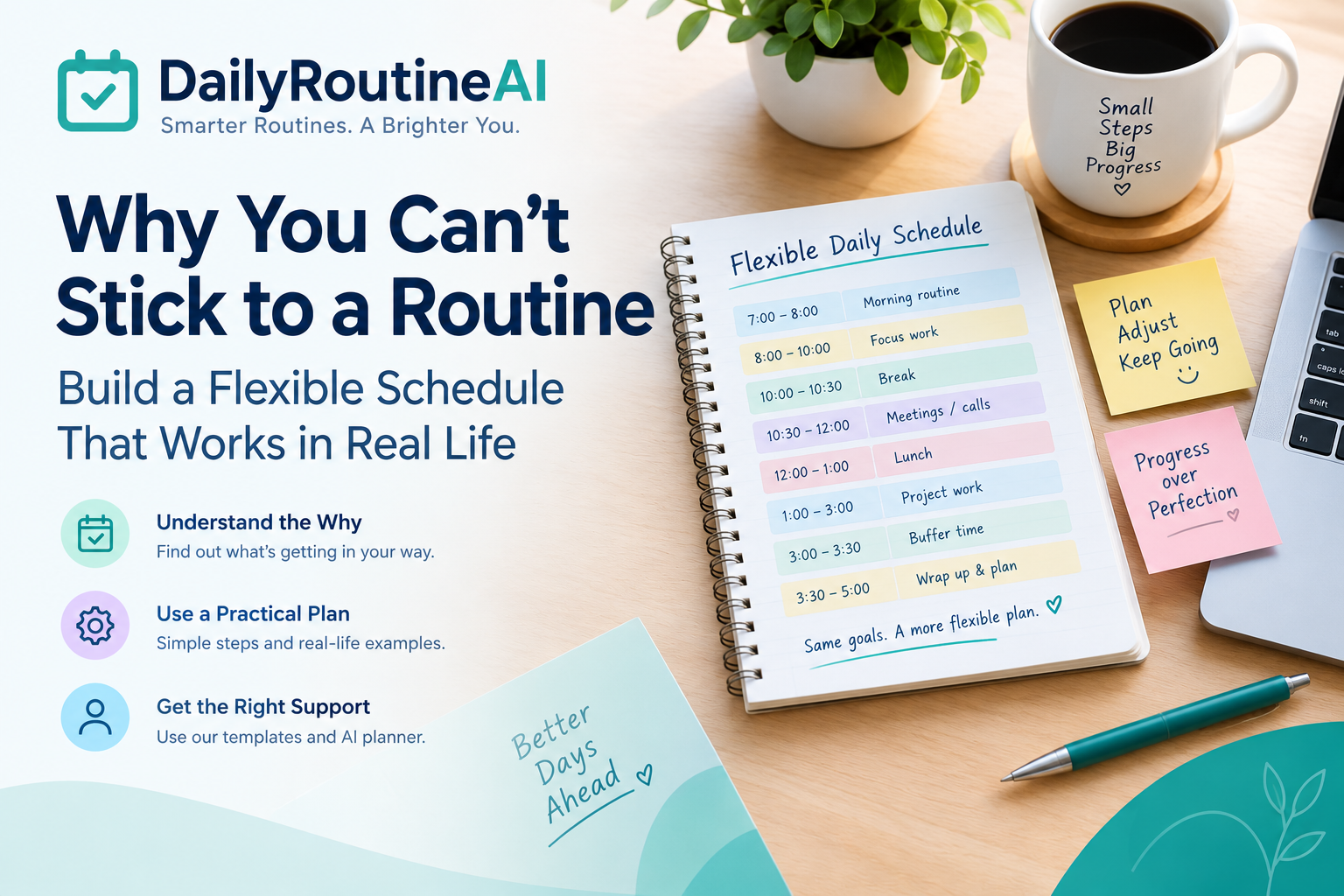
Step 4: Schedule tasks in flexible time blocks
Time blocking means reserving portions of your day for specific activities or categories of work.
Instead of scheduling every task to an exact minute, group related activities into blocks and leave room for changes.
For example:
| Time | Activity |
|---|---|
| 7:00–8:00 AM | Morning preparation and breakfast |
| 8:00–10:00 AM | Focused work |
| 10:00–10:30 AM | Break and messages |
| 10:30 AM–12:00 PM | Meetings or priority tasks |
| 12:00–1:00 PM | Lunch and reset |
| 1:00–3:00 PM | Project work |
| 3:00–3:30 PM | Buffer time |
| 3:30–5:00 PM | Remaining work and wrap-up |
| Evening | Personal responsibilities and preparation for tomorrow |
This is an illustrative schedule, not a universal recommendation. Adjust the times to your work hours, family responsibilities, and preferred sleep schedule.
For a more detailed planning starting point, use our free daily routine template to organize priorities, time blocks, and changes.
Step 5: Create a minimum version of your routine
Your normal routine won’t always fit your available time or energy. That’s why it’s useful to decide what a shorter version looks like before you need it.
For example:
| Activity | Regular version | Minimum version |
|---|---|---|
| Daily planning | Review the full day | Choose one priority |
| Exercise | Complete your planned workout | Do a short, manageable movement session if appropriate |
| Reading | Read for 20 minutes | Read one page |
| Personal project | Work for 45 minutes | Make one small, concrete step |
| Evening preparation | Review tasks and prepare belongings | Check tomorrow’s first commitment |
The minimum version isn’t a replacement for every full session. It’s an option for days when the original plan doesn’t fit.
Keep it realistic. A smaller action that you can actually complete may be more useful than a demanding plan you repeatedly postpone.
Step 6: Review the routine and adjust it
A routine is a working plan, not a permanent contract.
At the end of the day, ask yourself:
- Which parts of my routine worked?
- Where did I run out of time?
- Which task took longer than expected?
- What could I remove, shorten, or move tomorrow?
Look for recurring problems rather than judging a single day.
If you repeatedly skip a particular activity, the timing, duration, or priority may need to change. You may also discover that the activity is not as important as you originally thought.
Make small adjustments and give the revised plan a fair trial.
The Three-Level Routine System: Normal, Busy, and Low-Energy Days
One practical way to make a routine more adaptable is to prepare three versions of the same basic plan.
Instead of asking, “Can I follow my entire schedule today?” ask, “Which version of my routine fits today’s circumstances?”
Level 1: Your normal-day routine
Use this version when your time and energy are reasonably aligned with your plan.
It may include your usual work blocks, personal goals, exercise, breaks, and evening preparation.
Keep the plan realistic even on good days. Avoid adding extra tasks simply because you feel productive in the morning.
Level 2: Your busy-day routine
Use this version when meetings, deadlines, errands, or family responsibilities reduce your available time.
Your busy-day plan might include:
- One essential work priority
- Fixed commitments
- Basic meal and break arrangements
- One short personal task, if time permits
- A brief review of what can move to tomorrow
Remove optional activities before you start squeezing every task into a smaller window.
Level 3: Your low-energy routine
Some days call for a lighter plan. You may be tired, recovering from a demanding week, or simply dealing with more responsibilities than usual.
A low-energy routine can focus on essential commitments, manageable tasks, breaks, and postponing non-urgent work where possible.
For example, instead of completing an hour-long personal project, you might make a short note about the next step and return to it when you have the capacity.
If you want a starting point, our free daily routine template can help you map out a simpler day.
This approach isn’t about diagnosing why your energy changes. It’s about making your schedule responsive to your current circumstances.
What to Do When Your Routine Falls Apart Midday
Even a well-designed routine can be disrupted. The useful skill is knowing how to recover without trying to force the original plan back into place.
Use this five-minute reset.
1. Stop trying to catch up with everything.
Look at what has changed. Don’t automatically carry every missed task into the remaining hours.
2. Identify what still matters today.
Choose the task or commitment that has the most important consequence if it is delayed.
3. Move, shorten, or remove tasks.
Some tasks can be completed later. Others can be shortened or postponed. A few may no longer need to happen today.
4. Protect the next realistic block.
Choose one activity you can start now or at the next suitable time. Give yourself enough room to complete it without creating another unrealistic chain of commitments.
5. Finish with a revised plan.
Update the remaining schedule. If the day is almost over, focus on essential responsibilities and a simple plan for tomorrow.
For example, suppose your first meeting runs 45 minutes late and pushes your work schedule off track. Instead of rushing through every later task, move a non-urgent administrative activity to tomorrow, protect the most important project block, and retain a short wrap-up period.
The goal isn’t to rescue the original schedule. It’s to make a better plan for the time that remains.
How AI Can Help You Build a More Flexible Routine
An AI planning tool can help organize tasks, suggest time blocks, and revise a schedule when your commitments change. Its usefulness depends on the information you provide and whether you review the suggestions against your real circumstances.
For example, you could ask an AI assistant to:
- Organize your tasks around fixed meetings.
- Separate essential tasks from optional activities.
- Suggest a shorter version of your daily plan.
- Identify tasks that could move to another day.
- Create a realistic schedule with breaks and buffer time.
AI-generated schedules still need your judgment. A tool may misunderstand task duration, overlook a commitment, or suggest an unrealistic workload if you haven’t provided enough context.
If you’d like help building a personalized daily schedule, try Routine Architect, the free AI planning tool from DailyRoutineAI. Use it as a starting point, then adjust the schedule to match your actual responsibilities and preferences.
The aim is not to follow an AI-generated plan perfectly. It’s to spend less time organizing your day and more time using a plan that makes sense for you.
A Simple Seven-Day Plan to Rebuild Your Routine
If your previous attempts haven’t lasted, don’t start by changing everything again. Use the next seven days to make your routine more manageable.
| Day | Focus | What to do |
|---|---|---|
| Day 1 | Identify the problem | Write down what usually disrupts your routine. |
| Day 2 | Choose priorities | Select one to three realistic daily priorities. |
| Day 3 | Establish an anchor | Connect one small habit to an activity you already do. |
| Day 4 | Add time blocks | Schedule important tasks and leave some open time. |
| Day 5 | Create a backup plan | Decide what you’ll do on busy or low-energy days. |
| Day 6 | Practice recovery | If your plan changes, revise the remaining schedule rather than abandoning it. |
| Day 7 | Review and adjust | Keep what worked, remove unnecessary steps, and revise unrealistic blocks. |
Treat this as a starting experiment, not a test you can pass or fail. If a step takes longer than a day to establish, give yourself more time.
At the end of the week, evaluate whether the routine is easier to use and whether it reflects your actual commitments. You don’t need a perfect seven-day streak to learn something useful about your schedule.
Frequently Asked Questions
Why can’t I stick to a routine even when I really want to?
Wanting a routine doesn’t automatically make it practical. The plan may be too demanding, lack clear starting cues, or leave no room for changing responsibilities. Review what repeatedly gets in the way and adjust one part of the routine at a time.
How do I get back into a routine after falling off?
Start with the next useful action rather than trying to make up for every missed task. Choose one priority, use a manageable time block, and revise the rest of your schedule. You don’t have to wait until Monday or the start of a new month.
How long does it take to stick to a routine?
There is no single timeline that applies to every person or habit. The time required depends on the behavior, its complexity, and the circumstances in which you repeat it. Focus on making the routine practical and reviewing what works instead of relying on a universal deadline.
Should I follow the same routine every day?
Not necessarily. Some activities benefit from consistency, while others need to move around work, family, and other commitments. You can keep a few dependable anchors while changing the timing or length of less essential activities.
What if my daily schedule changes all the time?
Use flexible time blocks and plan around commitments that are known in advance. Identify a few priorities, keep a list of tasks that can move, and leave open space for unexpected work. A routine based on adaptable blocks may suit a changing schedule better than a strict timetable.
Is it better to have a morning routine or an evening routine?
Neither is automatically better. Choose the part of the day where a small amount of structure would be most useful. A morning routine might help you start work, while an evening routine might help you prepare for tomorrow. Begin with whichever fits your circumstances.
Can an AI planner help me stick to a routine?
An AI planner can help organize tasks, create time blocks, and revise a schedule when plans change. It cannot guarantee that you’ll follow the plan, and its suggestions may need correction. Use it to support your decisions rather than treating its schedule as a rule you must follow.
Final Thoughts: Build a Routine You Can Return To
If you can’t stick to a routine, another ambitious schedule may not be the answer. Start by understanding what makes your current plan difficult to follow.
Choose a few priorities, connect small habits to activities you already do, leave room for delays, and prepare a shorter version of your routine for demanding days.
Most importantly, decide how you’ll respond when something goes wrong. A useful routine should help you recover from interruptions instead of making you feel that one missed task has ruined the day.
Start small, review your experience, and change what doesn’t fit. Your goal is not to create a perfect schedule. It’s to build a flexible system that helps you make progress in the life you have today.